Cours
Plan du chapitre. I. Limites usuelles --- II. Opérations sur les limites --- III. Limites des polynômes et des fonctions rationnelles --- IV. Limites des fonctions trigonométriques --- V. Limites et ordre --- VI. Lecture graphique des limites.
Durée indicative : 11 heures. Prérequis : généralités sur les fonctions numériques, calcul numérique, ordre dans R \mathbb{R} R
I. Limites usuelles
Activité 1
On considère les fonctions x ↦ x 2 x\mapsto x^2 x ↦ x 2 x ↦ x 3 x\mapsto x^3 x ↦ x 3 x ↦ x x\mapsto\sqrt{x} x ↦ x x ↦ 1 x x\mapsto\dfrac1x x ↦ x 1
Calculer x 2 x^2 x 2 x 3 x^3 x 3 x \sqrt{x} x 1 x \dfrac1x x 1 x ∈ { 4 ; 25 ; 100 ; 10 4 ; 10 6 } x\in\{4\,;\,25\,;\,100\,;\,10^4\,;\,10^6\} x ∈ { 4 ; 25 ; 100 ; 1 0 4 ; 1 0 6 }
Que deviennent x 2 x^2 x 2 x 3 x^3 x 3 x \sqrt x x x x x 1 x \dfrac1x x 1
Voir la solution
1)
x x x 4 4 4 25 25 25 100 100 100 10 4 10^4 1 0 4 10 6 10^6 1 0 6 x 2 x^2 x 2 16 16 16 625 625 625 10 4 10^4 1 0 4 10 8 10^8 1 0 8 10 12 10^{12} 1 0 12 x 3 x^3 x 3 64 64 64 15 625 15\,625 15 625 10 6 10^6 1 0 6 10 12 10^{12} 1 0 12 10 18 10^{18} 1 0 18 x \sqrt x x 2 2 2 5 5 5 10 10 10 100 100 100 1000 1000 1000 1 x \frac1x x 1 0,25 0{,}25 0 , 25 0,04 0{,}04 0 , 04 0,01 0{,}01 0 , 01 10 − 4 10^{-4} 1 0 − 4 10 − 6 10^{-6} 1 0 − 6
2) Les nombres x 2 x^2 x 2 x 3 x^3 x 3 x \sqrt x x tendent vers + ∞ +\infty + ∞ quand x x x + ∞ +\infty + ∞ lim x → + ∞ x 2 = + ∞ \lim\limits_{x\to+\infty}x^2=+\infty x → + ∞ lim x 2 = + ∞ lim x → + ∞ x 3 = + ∞ \lim\limits_{x\to+\infty}x^3=+\infty x → + ∞ lim x 3 = + ∞ lim x → + ∞ x = + ∞ \lim\limits_{x\to+\infty}\sqrt x=+\infty x → + ∞ lim x = + ∞
Le nombre 1 x \dfrac1x x 1 0 0 0 lim x → + ∞ 1 x = 0 \lim\limits_{x\to+\infty}\dfrac1x=0 x → + ∞ lim x 1 = 0
Activité 2
Calculer 1 x \dfrac1x x 1 x ∈ { − 0,1 ; − 0,01 ; − 0,001 } x\in\{-0{,}1\,;-0{,}01\,;-0{,}001\} x ∈ { − 0 , 1 ; − 0 , 01 ; − 0 , 001 } x ∈ { 0,001 ; 0,01 ; 0,1 } x\in\{0{,}001\,;0{,}01\,;0{,}1\} x ∈ { 0 , 001 ; 0 , 01 ; 0 , 1 }
Que devient 1 x \dfrac1x x 1 x x x 0 0 0
Voir la solution
1)
x x x − 0,1 -0{,}1 − 0 , 1 − 0,01 -0{,}01 − 0 , 01 − 0,001 -0{,}001 − 0 , 001 0,001 0{,}001 0 , 001 0,01 0{,}01 0 , 01 0,1 0{,}1 0 , 1 1 x \frac1x x 1 − 10 -10 − 10 − 100 -100 − 100 − 1000 -1000 − 1000 1000 1000 1000 100 100 100 10 10 10
2) Lorsque x x x 0 0 0 x > 0 x>0 x > 0 1 x \dfrac1x x 1 limite à droite en 0 0 0 lim x → 0 + 1 x = + ∞ \lim\limits_{x\to0^+}\dfrac1x=+\infty x → 0 + lim x 1 = + ∞ lim x → 0 x > 0 1 x = + ∞ \lim\limits_{\substack{x\to0\\x>0}}\dfrac1x=+\infty x → 0 x > 0 lim x 1 = + ∞
Lorsque x x x 0 0 0 x < 0 x<0 x < 0 1 x \dfrac1x x 1 limite à gauche , lim x → 0 − 1 x = − ∞ \lim\limits_{x\to0^-}\dfrac1x=-\infty x → 0 − lim x 1 = − ∞
Propriété 1 (limites usuelles, admises)
Soit n ∈ N ∗ n\in\mathbb{N}^* n ∈ N ∗
En + ∞ +\infty + ∞ En − ∞ -\infty − ∞ En 0 0 0 lim x → + ∞ x n = + ∞ \lim\limits_{x\to+\infty}x^n=+\infty x → + ∞ lim x n = + ∞ lim x → − ∞ x n = + ∞ \lim\limits_{x\to-\infty}x^n=+\infty x → − ∞ lim x n = + ∞ n n n − ∞ -\infty − ∞ n n n lim x → 0 x n = 0 \lim\limits_{x\to0}x^n=0 x → 0 lim x n = 0 lim x → + ∞ 1 x n = 0 \lim\limits_{x\to+\infty}\dfrac1{x^n}=0 x → + ∞ lim x n 1 = 0 lim x → − ∞ 1 x n = 0 \lim\limits_{x\to-\infty}\dfrac1{x^n}=0 x → − ∞ lim x n 1 = 0 lim x → 0 + 1 x n = + ∞ \lim\limits_{x\to0^+}\dfrac1{x^n}=+\infty x → 0 + lim x n 1 = + ∞ lim x → + ∞ x = + ∞ \lim\limits_{x\to+\infty}\sqrt x=+\infty x → + ∞ lim x = + ∞ lim x → 0 − 1 x n = + ∞ \lim\limits_{x\to0^-}\dfrac1{x^n}=+\infty x → 0 − lim x n 1 = + ∞ n n n − ∞ -\infty − ∞ n n n lim x → + ∞ 1 x = 0 \lim\limits_{x\to+\infty}\dfrac1{\sqrt x}=0 x → + ∞ lim x 1 = 0 lim x → 0 + x = 0 \lim\limits_{x\to0^+}\sqrt x=0 x → 0 + lim x = 0 lim x → 0 + 1 x = + ∞ \lim\limits_{x\to0^+}\dfrac1{\sqrt x}=+\infty x → 0 + lim x 1 = + ∞
La fonction x ↦ x x\mapsto\sqrt x x ↦ x [ 0 ; + ∞ [ [0\,;+\infty[ [ 0 ; + ∞ [ − ∞ -\infty − ∞ 0 0 0
Exemple 1
Calculer les limites suivantes :
lim x → + ∞ x 6 \lim\limits_{x\to+\infty}x^6 x → + ∞ lim x 6 lim x → + ∞ x 3 \lim\limits_{x\to+\infty}x^3 x → + ∞ lim x 3 lim x → − ∞ x 6 \lim\limits_{x\to-\infty}x^6 x → − ∞ lim x 6 lim x → − ∞ x 3 \lim\limits_{x\to-\infty}x^3 x → − ∞ lim x 3 lim x → + ∞ x \lim\limits_{x\to+\infty}\sqrt x x → + ∞ lim x lim x → + ∞ 1 x 4 \lim\limits_{x\to+\infty}\dfrac1{x^4} x → + ∞ lim x 4 1 lim x → + ∞ 1 x \lim\limits_{x\to+\infty}\dfrac1{\sqrt x} x → + ∞ lim x 1 lim x → 0 + 1 x 4 \lim\limits_{x\to0^+}\dfrac1{x^4} x → 0 + lim x 4 1 lim x → 0 − 1 x 4 \lim\limits_{x\to0^-}\dfrac1{x^4} x → 0 − lim x 4 1 lim x → 0 + 1 x 5 \lim\limits_{x\to0^+}\dfrac1{x^5} x → 0 + lim x 5 1 lim x → 0 − 1 x 5 \lim\limits_{x\to0^-}\dfrac1{x^5} x → 0 − lim x 5 1 lim x → 0 1 x 4 \lim\limits_{x\to0}\dfrac1{x^4} x → 0 lim x 4 1 lim x → 0 1 x 5 \lim\limits_{x\to0}\dfrac1{x^5} x → 0 lim x 5 1 lim x → 0 x 3 \lim\limits_{x\to0}x^3 x → 0 lim x 3 lim x → − ∞ 1 x 5 \lim\limits_{x\to-\infty}\dfrac1{x^5} x → − ∞ lim x 5 1 lim x → − ∞ 1 x 4 \lim\limits_{x\to-\infty}\dfrac1{x^4} x → − ∞ lim x 4 1 lim x → 0 + 1 x \lim\limits_{x\to0^+}\dfrac1{\sqrt x} x → 0 + lim x 1 lim x → − ∞ 1 x \lim\limits_{x\to-\infty}\dfrac1{\sqrt x} x → − ∞ lim x 1 lim x → + ∞ x 6 × 1 x 3 \lim\limits_{x\to+\infty}x^6\times\dfrac1{x^3} x → + ∞ lim x 6 × x 3 1 lim x → + ∞ x 2 x \lim\limits_{x\to+\infty}\dfrac{x^2}{\sqrt x} x → + ∞ lim x x 2 lim x → 0 + x \lim\limits_{x\to0^+}\sqrt x x → 0 + lim x
Voir la solution
On applique la propriété 1, en regardant la parité de l’exposant.
lim x → + ∞ x 6 = + ∞ \lim\limits_{x\to+\infty}x^6=+\infty x → + ∞ lim x 6 = + ∞ lim x → + ∞ x 3 = + ∞ \ \lim\limits_{x\to+\infty}x^3=+\infty x → + ∞ lim x 3 = + ∞ lim x → − ∞ x 6 = + ∞ \ \lim\limits_{x\to-\infty}x^6=+\infty x → − ∞ lim x 6 = + ∞ 6 6 6 lim x → − ∞ x 3 = − ∞ \ \lim\limits_{x\to-\infty}x^3=-\infty x → − ∞ lim x 3 = − ∞ 3 3 3 lim x → + ∞ x = + ∞ \lim\limits_{x\to+\infty}\sqrt x=+\infty x → + ∞ lim x = + ∞ lim x → + ∞ 1 x 4 = 0 \ \lim\limits_{x\to+\infty}\dfrac1{x^4}=0 x → + ∞ lim x 4 1 = 0 lim x → + ∞ 1 x = 0 \ \lim\limits_{x\to+\infty}\dfrac1{\sqrt x}=0 x → + ∞ lim x 1 = 0 lim x → 0 + 1 x 4 = + ∞ \lim\limits_{x\to0^+}\dfrac1{x^4}=+\infty x → 0 + lim x 4 1 = + ∞ lim x → 0 − 1 x 4 = + ∞ \lim\limits_{x\to0^-}\dfrac1{x^4}=+\infty x → 0 − lim x 4 1 = + ∞ 4 4 4 lim x → 0 1 x 4 = + ∞ \lim\limits_{x\to0}\dfrac1{x^4}=+\infty x → 0 lim x 4 1 = + ∞ lim x → 0 + 1 x 5 = + ∞ \lim\limits_{x\to0^+}\dfrac1{x^5}=+\infty x → 0 + lim x 5 1 = + ∞ lim x → 0 − 1 x 5 = − ∞ \lim\limits_{x\to0^-}\dfrac1{x^5}=-\infty x → 0 − lim x 5 1 = − ∞ 5 5 5 1 x 5 \dfrac1{x^5} x 5 1 n’a pas de limite en 0 0 0 lim x → 0 x 3 = 0 \lim\limits_{x\to0}x^3=0 x → 0 lim x 3 = 0 lim x → − ∞ 1 x 5 = 0 \ \lim\limits_{x\to-\infty}\dfrac1{x^5}=0 x → − ∞ lim x 5 1 = 0 lim x → − ∞ 1 x 4 = 0 \ \lim\limits_{x\to-\infty}\dfrac1{x^4}=0 x → − ∞ lim x 4 1 = 0 lim x → 0 + 1 x = + ∞ \ \lim\limits_{x\to0^+}\dfrac1{\sqrt x}=+\infty x → 0 + lim x 1 = + ∞ lim x → − ∞ 1 x \lim\limits_{x\to-\infty}\dfrac1{\sqrt x} x → − ∞ lim x 1 1 x \dfrac1{\sqrt x} x 1 x > 0 x>0 x > 0 Pour x > 0 x>0 x > 0 x 6 × 1 x 3 = x 3 x^6\times\dfrac1{x^3}=x^3 x 6 × x 3 1 = x 3 lim x → + ∞ x 6 × 1 x 3 = lim x → + ∞ x 3 = + ∞ \lim\limits_{x\to+\infty}x^6\times\dfrac1{x^3}=\lim\limits_{x\to+\infty}x^3=+\infty x → + ∞ lim x 6 × x 3 1 = x → + ∞ lim x 3 = + ∞
Pour x > 0 x>0 x > 0 x 2 x = x 2 x x = x x \dfrac{x^2}{\sqrt x}=\dfrac{x^2\sqrt x}{x}=x\sqrt x x x 2 = x x 2 x = x x lim x → + ∞ x = + ∞ \lim\limits_{x\to+\infty}x=+\infty x → + ∞ lim x = + ∞ lim x → + ∞ x = + ∞ \lim\limits_{x\to+\infty}\sqrt x=+\infty x → + ∞ lim x = + ∞ lim x → + ∞ x 2 x = + ∞ \lim\limits_{x\to+\infty}\dfrac{x^2}{\sqrt x}=+\infty x → + ∞ lim x x 2 = + ∞
lim x → 0 + x = 0 \lim\limits_{x\to0^+}\sqrt x=0 x → 0 + lim x = 0
Propriété 2
Soit f f f a a a ℓ \ell ℓ ± ∞ \pm\infty ± ∞ lim x → a f ( x ) = ℓ ⟺ lim x → a + f ( x ) = ℓ et lim x → a − f ( x ) = ℓ . \lim_{x\to a}f(x)=\ell\iff\lim_{x\to a^+}f(x)=\ell\ \text{ et }\ \lim_{x\to a^-}f(x)=\ell. lim x → a f ( x ) = ℓ ⟺ lim x → a + f ( x ) = ℓ et lim x → a − f ( x ) = ℓ . lim x → a + f ( x ) ≠ lim x → a − f ( x ) \lim\limits_{x\to a^+}f(x)\neq\lim\limits_{x\to a^-}f(x) x → a + lim f ( x ) = x → a − lim f ( x ) f f f a a a
Exemple 2
Soit f f f f ( x ) = 2 x − 1 f(x)=2\sqrt x-1 f ( x ) = 2 x − 1 x > 4 x>4 x > 4 f ( x ) = x − 2 + 4 x f(x)=x-2+\dfrac4x f ( x ) = x − 2 + x 4 x < 4 x<4 x < 4 x ≠ 0 x\neq0 x = 0
Calculer f ( 16 ) f(16) f ( 16 ) f ( 9 ) f(9) f ( 9 ) f ( 1 ) f(1) f ( 1 ) f ( 2 ) f(2) f ( 2 ) f ( 3 ) f(3) f ( 3 )
Calculer lim x → 4 + f ( x ) \lim\limits_{x\to4^+}f(x) x → 4 + lim f ( x ) lim x → 4 − f ( x ) \lim\limits_{x\to4^-}f(x) x → 4 − lim f ( x )
La fonction f f f 4 4 4
Calculer lim x → 0 + f ( x ) \lim\limits_{x\to0^+}f(x) x → 0 + lim f ( x ) lim x → 0 − f ( x ) \lim\limits_{x\to0^-}f(x) x → 0 − lim f ( x )
Voir la solution
1) 16 > 4 16>4 16 > 4 9 > 4 9>4 9 > 4 f ( 16 ) = 2 × 4 − 1 = 7 f(16)=2\times4-1=7 f ( 16 ) = 2 × 4 − 1 = 7 f ( 9 ) = 2 × 3 − 1 = 5 f(9)=2\times3-1=5 f ( 9 ) = 2 × 3 − 1 = 5 1 < 4 1<4 1 < 4 2 < 4 2<4 2 < 4 3 < 4 3<4 3 < 4 f ( 1 ) = 1 − 2 + 4 = 3 f(1)=1-2+4=3 f ( 1 ) = 1 − 2 + 4 = 3 f ( 2 ) = 2 − 2 + 2 = 2 f(2)=2-2+2=2 f ( 2 ) = 2 − 2 + 2 = 2 f ( 3 ) = 3 − 2 + 4 3 = 7 3 f(3)=3-2+\dfrac43=\dfrac73 f ( 3 ) = 3 − 2 + 3 4 = 3 7
2) À droite de 4 4 4 lim x → 4 + f ( x ) = lim x → 4 + ( 2 x − 1 ) = 2 × 2 − 1 = 3 \lim\limits_{x\to4^+}f(x)=\lim\limits_{x\to4^+}\big(2\sqrt x-1\big)=2\times2-1=3 x → 4 + lim f ( x ) = x → 4 + lim ( 2 x − 1 ) = 2 × 2 − 1 = 3 4 4 4 lim x → 4 − f ( x ) = lim x → 4 − ( x − 2 + 4 x ) = 4 − 2 + 1 = 3 \lim\limits_{x\to4^-}f(x)=\lim\limits_{x\to4^-}\Big(x-2+\dfrac4x\Big)=4-2+1=3 x → 4 − lim f ( x ) = x → 4 − lim ( x − 2 + x 4 ) = 4 − 2 + 1 = 3
3) Les limites à droite et à gauche en 4 4 4 3 3 3 lim x → 4 f ( x ) = 3 \lim\limits_{x\to4}f(x)=3 x → 4 lim f ( x ) = 3 f f f 4 4 4
4) On a lim x → 0 ( x − 2 ) = − 2 \lim\limits_{x\to0}(x-2)=-2 x → 0 lim ( x − 2 ) = − 2 lim x → 0 + 4 x = + ∞ \lim\limits_{x\to0^+}\dfrac4x=+\infty x → 0 + lim x 4 = + ∞ lim x → 0 − 4 x = − ∞ \lim\limits_{x\to0^-}\dfrac4x=-\infty x → 0 − lim x 4 = − ∞ lim x → 0 + f ( x ) = + ∞ \lim\limits_{x\to0^+}f(x)=+\infty x → 0 + lim f ( x ) = + ∞ lim x → 0 − f ( x ) = − ∞ \lim\limits_{x\to0^-}f(x)=-\infty x → 0 − lim f ( x ) = − ∞ f f f 0 0 0
Remarque
Pour parler de la limite de f f f a a a a a a + ∞ +\infty + ∞ − ∞ -\infty − ∞ f f f au voisinage de a a a ] a − r ; a [ ∪ ] a ; a + r [ ]a-r\,;a[\,\cup\,]a\,;a+r[ ] a − r ; a [ ∪ ] a ; a + r [ ] a ; a + r [ ]a\,;a+r[ ] a ; a + r [ ] a − r ; a [ ]a-r\,;a[ ] a − r ; a [ ] A ; + ∞ [ ]A\,;+\infty[ ] A ; + ∞ [ ] − ∞ ; A [ ]-\infty\,;A[ ] − ∞ ; A [ D f D_f D f r > 0 r>0 r > 0
II. Opérations sur les limites
Propriété 3 (admise)
Dans les tableaux, ℓ \ell ℓ ℓ ′ \ell' ℓ ′ forme indéterminée : on ne peut pas conclure directement.
lim f \lim f lim f ℓ \ell ℓ ℓ \ell ℓ + ∞ +\infty + ∞ − ∞ -\infty − ∞ + ∞ +\infty + ∞ lim g \lim g lim g ℓ ′ \ell' ℓ ′ ± ∞ \pm\infty ± ∞ + ∞ +\infty + ∞ − ∞ -\infty − ∞ − ∞ -\infty − ∞ lim ( f + g ) \lim(f+g) lim ( f + g ) ℓ + ℓ ′ \ell+\ell' ℓ + ℓ ′ ± ∞ \pm\infty ± ∞ + ∞ +\infty + ∞ − ∞ -\infty − ∞ F.I.
lim f \lim f lim f ℓ \ell ℓ ℓ > 0 \ell>0 ℓ > 0 ℓ < 0 \ell<0 ℓ < 0 + ∞ +\infty + ∞ + ∞ +\infty + ∞ − ∞ -\infty − ∞ 0 0 0 lim g \lim g lim g ℓ ′ \ell' ℓ ′ ± ∞ \pm\infty ± ∞ ± ∞ \pm\infty ± ∞ + ∞ +\infty + ∞ − ∞ -\infty − ∞ − ∞ -\infty − ∞ ± ∞ \pm\infty ± ∞ lim ( f × g ) \lim(f\times g) lim ( f × g ) ℓ ℓ ′ \ell\ell' ℓ ℓ ′ ± ∞ \pm\infty ± ∞ ∓ ∞ \mp\infty ∓ ∞ + ∞ +\infty + ∞ − ∞ -\infty − ∞ + ∞ +\infty + ∞ F.I.
lim f \lim f lim f ℓ \ell ℓ ℓ \ell ℓ ℓ > 0 \ell>0 ℓ > 0 + ∞ +\infty + ∞ ℓ > 0 \ell>0 ℓ > 0 + ∞ +\infty + ∞ ± ∞ \pm\infty ± ∞ 0 0 0 lim g \lim g lim g ℓ ′ ≠ 0 \ell'\neq0 ℓ ′ = 0 ± ∞ \pm\infty ± ∞ 0 + 0^+ 0 + 0 − 0^- 0 − ± ∞ \pm\infty ± ∞ 0 0 0 lim f g \lim\dfrac fg lim g f ℓ ℓ ′ \dfrac{\ell}{\ell'} ℓ ′ ℓ 0 0 0 + ∞ +\infty + ∞ − ∞ -\infty − ∞ F.I. F.I.
(Si lim f = ℓ < 0 \lim f=\ell<0 lim f = ℓ < 0 − ∞ -\infty − ∞ 0 + 0^+ 0 + 0 − 0^- 0 − lim f = + ∞ \lim f=+\infty lim f = + ∞ lim f = + ∞ \lim\sqrt f=+\infty lim f = + ∞ n ∈ N ∗ n\in\mathbb{N}^* n ∈ N ∗ lim f = ± ∞ ⇒ lim f n = + ∞ \lim f=\pm\infty\Rightarrow\lim f^n=+\infty lim f = ± ∞ ⇒ lim f n = + ∞ n n n lim f n = lim f \lim f^n=\lim f lim f n = lim f n n n
Remarque
Il y a quatre formes indéterminées : « + ∞ − ∞ +\infty-\infty + ∞ − ∞ 0 × ∞ 0\times\infty 0 × ∞ ∞ ∞ \dfrac{\infty}{\infty} ∞ ∞ 0 0 \dfrac00 0 0 lever une indétermination, on transforme l’écriture : factorisation (identités remarquables, racines d’un trinôme, division euclidienne), multiplication par l’expression conjuguée, mise en facteur du terme dominant, changement de variable, encadrement (propriétés 4, 5 et 6).
Exemple 3
Calculer les limites suivantes :
lim x → + ∞ ( x 3 + 5 ) \lim\limits_{x\to+\infty}(x^3+5) x → + ∞ lim ( x 3 + 5 ) lim x → + ∞ ( 1 x + 1 x + x 2 ) \lim\limits_{x\to+\infty}\Big(\dfrac1x+\dfrac1{\sqrt x}+x^2\Big) x → + ∞ lim ( x 1 + x 1 + x 2 ) lim x → − ∞ ( x 3 + 2 x − 7 ) \lim\limits_{x\to-\infty}(x^3+2x-7) x → − ∞ lim ( x 3 + 2 x − 7 ) lim x → 0 + ( − 3 x − 2 x 2 + 1 ) \lim\limits_{x\to0^+}\Big(-\dfrac3x-\dfrac2{x^2}+1\Big) x → 0 + lim ( − x 3 − x 2 2 + 1 ) lim x → − ∞ ( 1 − x ) 3 ( − x 2 + 4 ) \lim\limits_{x\to-\infty}(1-x)^3(-x^2+4) x → − ∞ lim ( 1 − x ) 3 ( − x 2 + 4 ) lim x → 2 4 x + 1 x 2 − 5 \lim\limits_{x\to2}\dfrac{4x+1}{x^2-5} x → 2 lim x 2 − 5 4 x + 1 lim x → 0 − 2 − x x 2 \lim\limits_{x\to0^-}\dfrac{2-x}{x^2} x → 0 − lim x 2 2 − x lim x → 0 − − 4 x 3 \lim\limits_{x\to0^-}\dfrac{-4}{x^3} x → 0 − lim x 3 − 4 lim x → 2 + 5 − x + 2 \lim\limits_{x\to2^+}\dfrac{5}{-x+2} x → 2 + lim − x + 2 5 lim x → 3 − 6 3 − x \lim\limits_{x\to3^-}\dfrac6{3-x} x → 3 − lim 3 − x 6 lim x → ( − 3 ) + 1 x 2 + 4 x + 3 \lim\limits_{x\to(-3)^+}\dfrac1{x^2+4x+3} x → ( − 3 ) + lim x 2 + 4 x + 3 1 lim x → 2 − 2 x + 3 x 2 − 4 \lim\limits_{x\to2^-}\dfrac{2x+3}{x^2-4} x → 2 − lim x 2 − 4 2 x + 3
Voir la solution
lim x → + ∞ x 3 = + ∞ \lim\limits_{x\to+\infty}x^3=+\infty x → + ∞ lim x 3 = + ∞ lim x → + ∞ ( x 3 + 5 ) = + ∞ \lim\limits_{x\to+\infty}(x^3+5)=+\infty x → + ∞ lim ( x 3 + 5 ) = + ∞ 1 x → 0 \dfrac1x\to0 x 1 → 0 1 x → 0 \dfrac1{\sqrt x}\to0 x 1 → 0 x 2 → + ∞ x^2\to+\infty x 2 → + ∞ + ∞ +\infty + ∞ x 3 → − ∞ x^3\to-\infty x 3 → − ∞ 2 x − 7 → − ∞ 2x-7\to-\infty 2 x − 7 → − ∞ − ∞ − ∞ -\infty-\infty − ∞ − ∞ = − ∞ =-\infty = − ∞ − 3 x → − ∞ -\dfrac3x\to-\infty − x 3 → − ∞ − 2 x 2 → − ∞ -\dfrac2{x^2}\to-\infty − x 2 2 → − ∞ x → 0 + x\to0^+ x → 0 + − ∞ -\infty − ∞ 1 − x → + ∞ 1-x\to+\infty 1 − x → + ∞ ( 1 − x ) 3 → + ∞ (1-x)^3\to+\infty ( 1 − x ) 3 → + ∞ − x 2 + 4 → − ∞ -x^2+4\to-\infty − x 2 + 4 → − ∞ ( + ∞ ) × ( − ∞ ) (+\infty)\times(-\infty) ( + ∞ ) × ( − ∞ ) = − ∞ =-\infty = − ∞ 4 x + 1 → 9 4x+1\to9 4 x + 1 → 9 x 2 − 5 → − 1 ≠ 0 x^2-5\to-1\neq0 x 2 − 5 → − 1 = 0 9 − 1 = − 9 \dfrac9{-1}=-9 − 1 9 = − 9 2 − x → 2 2-x\to2 2 − x → 2 x 2 → 0 + x^2\to0^+ x 2 → 0 + 2 0 + \dfrac2{0^+} 0 + 2 = + ∞ =+\infty = + ∞ Pour x < 0 x<0 x < 0 x 3 < 0 x^3<0 x 3 < 0 x 3 → 0 − x^3\to0^- x 3 → 0 − − 4 0 − \dfrac{-4}{0^-} 0 − − 4 = + ∞ =+\infty = + ∞
Pour x > 2 x>2 x > 2 − x + 2 < 0 -x+2<0 − x + 2 < 0 − x + 2 → 0 − -x+2\to0^- − x + 2 → 0 − 5 0 − \dfrac5{0^-} 0 − 5 = − ∞ =-\infty = − ∞
Pour x < 3 x<3 x < 3 3 − x > 0 3-x>0 3 − x > 0 6 0 + \dfrac6{0^+} 0 + 6 = + ∞ =+\infty = + ∞
x 2 + 4 x + 3 = ( x + 1 ) ( x + 3 ) x^2+4x+3=(x+1)(x+3) x 2 + 4 x + 3 = ( x + 1 ) ( x + 3 ) − 3 -3 − 3 − 1 -1 − 1 a = 1 a=1 a = 1 x ∈ ] − 3 ; − 1 [ x\in\,]-3\,;-1[ x ∈ ] − 3 ; − 1 [ x 2 + 4 x + 3 < 0 x^2+4x+3<0 x 2 + 4 x + 3 < 0 x 2 + 4 x + 3 → 0 − x^2+4x+3\to0^- x 2 + 4 x + 3 → 0 − x → ( − 3 ) + x\to(-3)^+ x → ( − 3 ) + − ∞ -\infty − ∞ 2 x + 3 → 7 2x+3\to7 2 x + 3 → 7 x ∈ ] − 2 ; 2 [ x\in\,]-2\,;2[ x ∈ ] − 2 ; 2 [ x 2 − 4 < 0 x^2-4<0 x 2 − 4 < 0 x 2 − 4 → 0 − x^2-4\to0^- x 2 − 4 → 0 − 7 0 − \dfrac7{0^-} 0 − 7 = − ∞ =-\infty = − ∞
Méthode --- Rappels utiles
Signe d’un trinôme a x 2 + b x + c ax^2+bx+c a x 2 + b x + c Δ > 0 \Delta>0 Δ > 0 x 1 < x 2 x_1<x_2 x 1 < x 2 a a a [ x 1 ; x 2 ] [x_1\,;x_2] [ x 1 ; x 2 ] − a -a − a Factorisation : si x 1 x_1 x 1 x 2 x_2 x 2 a x 2 + b x + c = a ( x − x 1 ) ( x − x 2 ) ax^2+bx+c=a(x-x_1)(x-x_2) a x 2 + b x + c = a ( x − x 1 ) ( x − x 2 ) Division euclidienne : si P P P n ≥ 1 n\ge1 n ≥ 1 P ( α ) = 0 P(\alpha)=0 P ( α ) = 0 Q Q Q n − 1 n-1 n − 1 P ( x ) = ( x − α ) Q ( x ) P(x)=(x-\alpha)Q(x) P ( x ) = ( x − α ) Q ( x ) Q Q Q P ( x ) P(x) P ( x ) x − α x-\alpha x − α Identités : a 3 − b 3 = ( a − b ) ( a 2 + a b + b 2 ) a^3-b^3=(a-b)(a^2+ab+b^2) a 3 − b 3 = ( a − b ) ( a 2 + ab + b 2 ) a 3 + b 3 = ( a + b ) ( a 2 − a b + b 2 ) a^3+b^3=(a+b)(a^2-ab+b^2) a 3 + b 3 = ( a + b ) ( a 2 − ab + b 2 ) ( a ± b ) 3 = a 3 ± 3 a 2 b + 3 a b 2 ± b 3 (a\pm b)^3=a^3\pm3a^2b+3ab^2\pm b^3 ( a ± b ) 3 = a 3 ± 3 a 2 b + 3 a b 2 ± b 3 Expressions conjuguées (a , b ≥ 0 a,b\ge0 a , b ≥ 0 ( a − b ) ( a + b ) = a − b (\sqrt a-\sqrt b)(\sqrt a+\sqrt b)=a-b ( a − b ) ( a + b ) = a − b ( a − b ) ( a + b ) = a − b 2 (\sqrt a-b)(\sqrt a+b)=a-b^2 ( a − b ) ( a + b ) = a − b 2
Exemple 4
Calculer les limites suivantes (formes indéterminées) :
lim x → 2 x 2 − 4 x − 2 \lim\limits_{x\to2}\dfrac{x^2-4}{x-2} x → 2 lim x − 2 x 2 − 4 lim x → 2 3 x 2 − 5 x − 2 x − 2 \lim\limits_{x\to2}\dfrac{3x^2-5x-2}{x-2} x → 2 lim x − 2 3 x 2 − 5 x − 2 lim x → 2 2 x 2 − 3 x − 2 x 3 − x 2 − x − 2 \lim\limits_{x\to2}\dfrac{2x^2-3x-2}{x^3-x^2-x-2} x → 2 lim x 3 − x 2 − x − 2 2 x 2 − 3 x − 2 lim x → 2 x 3 − 8 x 3 − x 2 − x − 2 \lim\limits_{x\to2}\dfrac{x^3-8}{x^3-x^2-x-2} x → 2 lim x 3 − x 2 − x − 2 x 3 − 8 lim x → 2 x 2 − 2 x 4 − 2 x \lim\limits_{x\to2}\dfrac{x^2-2x}{4-2x} x → 2 lim 4 − 2 x x 2 − 2 x lim x → + ∞ ( x 2 x − 3 x ) \lim\limits_{x\to+\infty}\big(x^2\sqrt x-3x\big) x → + ∞ lim ( x 2 x − 3 x ) lim x → + ∞ ( 2 x − x ) \lim\limits_{x\to+\infty}\big(2x-\sqrt x\big) x → + ∞ lim ( 2 x − x )
Voir la solution
Les cinq premières limites sont de la forme « 0 0 \dfrac00 0 0 ( x − 2 ) (x-2) ( x − 2 ) x ≠ 2 x\neq2 x = 2
x 2 − 4 x − 2 = ( x − 2 ) ( x + 2 ) x − 2 = x + 2 \dfrac{x^2-4}{x-2}=\dfrac{(x-2)(x+2)}{x-2}=x+2 x − 2 x 2 − 4 = x − 2 ( x − 2 ) ( x + 2 ) = x + 2 4 4 4 2 2 2 3 x 2 − 5 x − 2 3x^2-5x-2 3 x 2 − 5 x − 2 c a = − 2 3 \dfrac ca=-\dfrac23 a c = − 3 2 − 1 3 -\dfrac13 − 3 1 3 x 2 − 5 x − 2 = ( x − 2 ) ( 3 x + 1 ) 3x^2-5x-2=(x-2)(3x+1) 3 x 2 − 5 x − 2 = ( x − 2 ) ( 3 x + 1 ) 3 x 2 − 5 x − 2 x − 2 = 3 x + 1 → 7 \dfrac{3x^2-5x-2}{x-2}=3x+1\to7 x − 2 3 x 2 − 5 x − 2 = 3 x + 1 → 7 2 x 2 − 3 x − 2 = ( x − 2 ) ( 2 x + 1 ) 2x^2-3x-2=(x-2)(2x+1) 2 x 2 − 3 x − 2 = ( x − 2 ) ( 2 x + 1 ) x 3 − x 2 − x − 2 x^3-x^2-x-2 x 3 − x 2 − x − 2 x − 2 x-2 x − 2 x 3 − x 2 − x − 2 = ( x − 2 ) ( x 2 + x + 1 ) x^3-x^2-x-2=(x-2)(x^2+x+1) x 3 − x 2 − x − 2 = ( x − 2 ) ( x 2 + x + 1 ) 2 x 2 − 3 x − 2 x 3 − x 2 − x − 2 = 2 x + 1 x 2 + x + 1 → 5 7 \dfrac{2x^2-3x-2}{x^3-x^2-x-2}=\dfrac{2x+1}{x^2+x+1}\to\dfrac57 x 3 − x 2 − x − 2 2 x 2 − 3 x − 2 = x 2 + x + 1 2 x + 1 → 7 5 x 3 − 8 = x 3 − 2 3 = ( x − 2 ) ( x 2 + 2 x + 4 ) x^3-8=x^3-2^3=(x-2)(x^2+2x+4) x 3 − 8 = x 3 − 2 3 = ( x − 2 ) ( x 2 + 2 x + 4 ) x 3 − 8 x 3 − x 2 − x − 2 = x 2 + 2 x + 4 x 2 + x + 1 → 12 7 \dfrac{x^3-8}{x^3-x^2-x-2}=\dfrac{x^2+2x+4}{x^2+x+1}\to\dfrac{12}7 x 3 − x 2 − x − 2 x 3 − 8 = x 2 + x + 1 x 2 + 2 x + 4 → 7 12 x 2 − 2 x 4 − 2 x = x ( x − 2 ) − 2 ( x − 2 ) = − x 2 → − 1 \dfrac{x^2-2x}{4-2x}=\dfrac{x(x-2)}{-2(x-2)}=-\dfrac x2\to-1 4 − 2 x x 2 − 2 x = − 2 ( x − 2 ) x ( x − 2 ) = − 2 x → − 1 Forme « + ∞ − ∞ +\infty-\infty + ∞ − ∞ x > 0 x>0 x > 0 x 2 x − 3 x = x ( x x − 3 ) x^2\sqrt x-3x=x\big(x\sqrt x-3\big) x 2 x − 3 x = x ( x x − 3 ) x → + ∞ x\to+\infty x → + ∞ x x − 3 → + ∞ x\sqrt x-3\to+\infty x x − 3 → + ∞ + ∞ +\infty + ∞
Forme « + ∞ − ∞ +\infty-\infty + ∞ − ∞ x > 0 x>0 x > 0 2 x − x = x ( 2 x − 1 ) 2x-\sqrt x=\sqrt x\big(2\sqrt x-1\big) 2 x − x = x ( 2 x − 1 ) + ∞ +\infty + ∞ + ∞ +\infty + ∞
Exemple 5
Calculer, à l’aide des expressions conjuguées :
lim x → 9 x − 9 x − 3 \lim\limits_{x\to9}\dfrac{x-9}{\sqrt x-3} x → 9 lim x − 3 x − 9 lim x → 4 3 x − 3 − 3 x − 4 \quad\lim\limits_{x\to4}\dfrac{\sqrt{3x-3}-3}{x-4} x → 4 lim x − 4 3 x − 3 − 3 lim x → 0 9 + x − 9 − x x \quad\lim\limits_{x\to0}\dfrac{\sqrt{9+x}-\sqrt{9-x}}{x} x → 0 lim x 9 + x − 9 − x lim x → 1 2 − x + 3 1 − 2 x − 1 \quad\lim\limits_{x\to1}\dfrac{2-\sqrt{x+3}}{1-\sqrt{2x-1}} x → 1 lim 1 − 2 x − 1 2 − x + 3
Voir la solution
Forme « 0 0 \dfrac00 0 0 x ≥ 0 x\ge0 x ≥ 0 x ≠ 9 x\neq9 x = 9 x − 9 x − 3 = ( x − 3 ) ( x + 3 ) x − 3 = x + 3 \dfrac{x-9}{\sqrt x-3}=\dfrac{(\sqrt x-3)(\sqrt x+3)}{\sqrt x-3}=\sqrt x+3 x − 3 x − 9 = x − 3 ( x − 3 ) ( x + 3 ) = x + 3 6 6 6
On multiplie numérateur et dénominateur par 3 x − 3 + 3 \sqrt{3x-3}+3 3 x − 3 + 3 3 x − 3 − 3 x − 4 = 3 x − 3 − 9 ( x − 4 ) ( 3 x − 3 + 3 ) = 3 3 x − 3 + 3 → 3 6 = 1 2 \dfrac{\sqrt{3x-3}-3}{x-4}=\dfrac{3x-3-9}{(x-4)(\sqrt{3x-3}+3)}=\dfrac{3}{\sqrt{3x-3}+3}\to\dfrac36=\dfrac12 x − 4 3 x − 3 − 3 = ( x − 4 ) ( 3 x − 3 + 3 ) 3 x − 3 − 9 = 3 x − 3 + 3 3 → 6 3 = 2 1
9 + x − 9 − x x = ( 9 + x ) − ( 9 − x ) x ( 9 + x + 9 − x ) = 2 9 + x + 9 − x → 2 6 = 1 3 \dfrac{\sqrt{9+x}-\sqrt{9-x}}{x}=\dfrac{(9+x)-(9-x)}{x(\sqrt{9+x}+\sqrt{9-x})}=\dfrac{2}{\sqrt{9+x}+\sqrt{9-x}}\to\dfrac26=\dfrac13 x 9 + x − 9 − x = x ( 9 + x + 9 − x ) ( 9 + x ) − ( 9 − x ) = 9 + x + 9 − x 2 → 6 2 = 3 1 Numérateur : 2 − x + 3 = 4 − ( x + 3 ) 2 + x + 3 = 1 − x 2 + x + 3 2-\sqrt{x+3}=\dfrac{4-(x+3)}{2+\sqrt{x+3}}=\dfrac{1-x}{2+\sqrt{x+3}} 2 − x + 3 = 2 + x + 3 4 − ( x + 3 ) = 2 + x + 3 1 − x 1 − 2 x − 1 = 1 − ( 2 x − 1 ) 1 + 2 x − 1 = 2 ( 1 − x ) 1 + 2 x − 1 1-\sqrt{2x-1}=\dfrac{1-(2x-1)}{1+\sqrt{2x-1}}=\dfrac{2(1-x)}{1+\sqrt{2x-1}} 1 − 2 x − 1 = 1 + 2 x − 1 1 − ( 2 x − 1 ) = 1 + 2 x − 1 2 ( 1 − x ) x ≠ 1 x\neq1 x = 1 2 − x + 3 1 − 2 x − 1 = 1 + 2 x − 1 2 ( 2 + x + 3 ) → 2 2 × 4 = 1 4 \dfrac{2-\sqrt{x+3}}{1-\sqrt{2x-1}}=\dfrac{1+\sqrt{2x-1}}{2\big(2+\sqrt{x+3}\big)}\to\dfrac{2}{2\times4}=\dfrac14 1 − 2 x − 1 2 − x + 3 = 2 ( 2 + x + 3 ) 1 + 2 x − 1 → 2 × 4 2 = 4 1
Remarque
Si f f f a a a unique . On dit que la limite est finie si c’est un réel, infinie si c’est + ∞ +\infty + ∞ − ∞ -\infty − ∞
lim x → a f ( x ) = ℓ ⟺ lim x → a ( f ( x ) − ℓ ) = 0 \lim\limits_{x\to a}f(x)=\ell\iff\lim\limits_{x\to a}\big(f(x)-\ell\big)=0 x → a lim f ( x ) = ℓ ⟺ x → a lim ( f ( x ) − ℓ ) = 0 Si lim f = ℓ \lim f=\ell lim f = ℓ lim 1 f = 1 ℓ \lim\dfrac1f=\dfrac1\ell lim f 1 = ℓ 1 ℓ ≠ 0 \ell\neq0 ℓ = 0 lim f = ℓ \lim\sqrt f=\sqrt\ell lim f = ℓ ℓ ≥ 0 \ell\ge0 ℓ ≥ 0 f ≥ 0 f\ge0 f ≥ 0 lim α f = α ℓ \lim\alpha f=\alpha\ell lim α f = α ℓ c c c lim c = c \lim c=c lim c = c
Si f f f lim x → − ∞ f ( x ) = lim x → + ∞ f ( x ) \lim\limits_{x\to-\infty}f(x)=\lim\limits_{x\to+\infty}f(x) x → − ∞ lim f ( x ) = x → + ∞ lim f ( x ) f f f lim x → − ∞ f ( x ) = − lim x → + ∞ f ( x ) \lim\limits_{x\to-\infty}f(x)=-\lim\limits_{x\to+\infty}f(x) x → − ∞ lim f ( x ) = − x → + ∞ lim f ( x )
III. Limites des polynômes et des fonctions rationnelles
Propriété 4
Soient P P P Q Q Q a a a Q ( a ) ≠ 0 Q(a)\neq0 Q ( a ) = 0
lim x → a P ( x ) = P ( a ) \lim\limits_{x\to a}P(x)=P(a) x → a lim P ( x ) = P ( a ) lim x → a P ( x ) Q ( x ) = P ( a ) Q ( a ) \lim\limits_{x\to a}\dfrac{P(x)}{Q(x)}=\dfrac{P(a)}{Q(a)} x → a lim Q ( x ) P ( x ) = Q ( a ) P ( a ) En + ∞ +\infty + ∞ − ∞ -\infty − ∞ terme de plus haut degré , et une fonction rationnelle a la même limite que le quotient des termes de plus haut degré : si a x n ax^n a x n b x m bx^m b x m lim x → ± ∞ P ( x ) Q ( x ) = lim x → ± ∞ a x n b x m \lim\limits_{x\to\pm\infty}\dfrac{P(x)}{Q(x)}=\lim\limits_{x\to\pm\infty}\dfrac{ax^n}{bx^m} x → ± ∞ lim Q ( x ) P ( x ) = x → ± ∞ lim b x m a x n
Exemple 6
Calculer les limites suivantes :
lim x → + ∞ ( x 3 − 5 x 4 + 2 x − 1 ) \lim\limits_{x\to+\infty}(x^3-5x^4+2x-1) x → + ∞ lim ( x 3 − 5 x 4 + 2 x − 1 ) lim x → − ∞ ( − 3 x 2 + 4 x + 7 ) \lim\limits_{x\to-\infty}(-3x^2+4x+7) x → − ∞ lim ( − 3 x 2 + 4 x + 7 ) lim x → − 1 ( 2 x 2 − x + 3 ) \lim\limits_{x\to-1}(2x^2-x+3) x → − 1 lim ( 2 x 2 − x + 3 ) lim x → + ∞ 2 x 4 − x + 1 x 3 − 4 x 6 + 2 \lim\limits_{x\to+\infty}\dfrac{2x^4-x+1}{x^3-4x^6+2} x → + ∞ lim x 3 − 4 x 6 + 2 2 x 4 − x + 1 lim x → − ∞ x 5 − 3 x + 1 2 x 2 + x − 4 \lim\limits_{x\to-\infty}\dfrac{x^5-3x+1}{2x^2+x-4} x → − ∞ lim 2 x 2 + x − 4 x 5 − 3 x + 1
Voir la solution
lim x → + ∞ ( x 3 − 5 x 4 + 2 x − 1 ) = lim x → + ∞ ( − 5 x 4 ) = − ∞ \lim\limits_{x\to+\infty}(x^3-5x^4+2x-1)=\lim\limits_{x\to+\infty}(-5x^4)=-\infty x → + ∞ lim ( x 3 − 5 x 4 + 2 x − 1 ) = x → + ∞ lim ( − 5 x 4 ) = − ∞ lim x → − ∞ ( − 3 x 2 + 4 x + 7 ) = lim x → − ∞ ( − 3 x 2 ) = − ∞ \lim\limits_{x\to-\infty}(-3x^2+4x+7)=\lim\limits_{x\to-\infty}(-3x^2)=-\infty x → − ∞ lim ( − 3 x 2 + 4 x + 7 ) = x → − ∞ lim ( − 3 x 2 ) = − ∞ C’est un polynôme : la limite est sa valeur en − 1 -1 − 1 2 + 1 + 3 = 6 2+1+3=6 2 + 1 + 3 = 6
lim x → + ∞ 2 x 4 − x + 1 x 3 − 4 x 6 + 2 = lim x → + ∞ 2 x 4 − 4 x 6 = lim x → + ∞ − 1 2 x 2 = 0 \lim\limits_{x\to+\infty}\dfrac{2x^4-x+1}{x^3-4x^6+2}=\lim\limits_{x\to+\infty}\dfrac{2x^4}{-4x^6}=\lim\limits_{x\to+\infty}\dfrac{-1}{2x^2}=0 x → + ∞ lim x 3 − 4 x 6 + 2 2 x 4 − x + 1 = x → + ∞ lim − 4 x 6 2 x 4 = x → + ∞ lim 2 x 2 − 1 = 0 lim x → − ∞ x 5 − 3 x + 1 2 x 2 + x − 4 = lim x → − ∞ x 5 2 x 2 = lim x → − ∞ x 3 2 = − ∞ \lim\limits_{x\to-\infty}\dfrac{x^5-3x+1}{2x^2+x-4}=\lim\limits_{x\to-\infty}\dfrac{x^5}{2x^2}=\lim\limits_{x\to-\infty}\dfrac{x^3}{2}=-\infty x → − ∞ lim 2 x 2 + x − 4 x 5 − 3 x + 1 = x → − ∞ lim 2 x 2 x 5 = x → − ∞ lim 2 x 3 = − ∞
Remarque
Lorsque la limite de a x 2 + b x + c + ( α x + β ) \sqrt{ax^2+bx+c}+(\alpha x+\beta) a x 2 + b x + c + ( α x + β ) ± ∞ \pm\infty ± ∞
si a = ∣ α ∣ \sqrt a=|\alpha| a = ∣ α ∣ x x x
si a ≠ ∣ α ∣ \sqrt a\neq|\alpha| a = ∣ α ∣ x 2 x^2 x 2 x 2 = ∣ x ∣ \sqrt{x^2}=|x| x 2 = ∣ x ∣ x 2 = x \sqrt{x^2}=x x 2 = x x > 0 x>0 x > 0 x 2 = − x \sqrt{x^2}=-x x 2 = − x x < 0 x<0 x < 0
Exemple 7
Calculer les limites suivantes :
lim x → + ∞ ( x 2 + 3 − x ) \lim\limits_{x\to+\infty}\big(\sqrt{x^2+3}-x\big) x → + ∞ lim ( x 2 + 3 − x ) lim x → − ∞ ( x 2 + 3 − x ) \lim\limits_{x\to-\infty}\big(\sqrt{x^2+3}-x\big) x → − ∞ lim ( x 2 + 3 − x ) lim x → + ∞ ( x 2 + 4 x + 1 − 2 x + 3 ) \lim\limits_{x\to+\infty}\big(\sqrt{x^2+4x+1}-2x+3\big) x → + ∞ lim ( x 2 + 4 x + 1 − 2 x + 3 ) lim x → − ∞ ( 4 x 2 − x + 2 + 2 x + 1 ) \lim\limits_{x\to-\infty}\big(\sqrt{4x^2-x+2}+2x+1\big) x → − ∞ lim ( 4 x 2 − x + 2 + 2 x + 1 )
Voir la solution
Forme « + ∞ − ∞ +\infty-\infty + ∞ − ∞ 1 = 1 \sqrt1=1 1 = 1 x 2 + 3 − x = ( x 2 + 3 ) − x 2 x 2 + 3 + x = 3 x 2 + 3 + x \sqrt{x^2+3}-x=\dfrac{(x^2+3)-x^2}{\sqrt{x^2+3}+x}=\dfrac{3}{\sqrt{x^2+3}+x} x 2 + 3 − x = x 2 + 3 + x ( x 2 + 3 ) − x 2 = x 2 + 3 + x 3 + ∞ +\infty + ∞ 0 0 0
En − ∞ -\infty − ∞ x 2 + 3 → + ∞ \sqrt{x^2+3}\to+\infty x 2 + 3 → + ∞ − x → + ∞ -x\to+\infty − x → + ∞ + ∞ +\infty + ∞
Forme « + ∞ − ∞ +\infty-\infty + ∞ − ∞ 1 ≠ 2 \sqrt1\neq2 1 = 2 x > 0 x>0 x > 0 x 2 + 4 x + 1 = x 1 + 4 x + 1 x 2 \sqrt{x^2+4x+1}=x\sqrt{1+\dfrac4x+\dfrac1{x^2}} x 2 + 4 x + 1 = x 1 + x 4 + x 2 1 x 2 + 4 x + 1 − 2 x + 3 = x ( 1 + 4 x + 1 x 2 − 2 + 3 x ) \sqrt{x^2+4x+1}-2x+3=x\Big(\sqrt{1+\dfrac4x+\dfrac1{x^2}}-2+\dfrac3x\Big) x 2 + 4 x + 1 − 2 x + 3 = x ( 1 + x 4 + x 2 1 − 2 + x 3 ) 1 − 2 = − 1 1-2=-1 1 − 2 = − 1 x → + ∞ x\to+\infty x → + ∞ − ∞ -\infty − ∞
En − ∞ -\infty − ∞ 4 x 2 − x + 2 → + ∞ \sqrt{4x^2-x+2}\to+\infty 4 x 2 − x + 2 → + ∞ 2 x + 1 → − ∞ 2x+1\to-\infty 2 x + 1 → − ∞ 4 = 2 = ∣ 2 ∣ \sqrt4=2=|2| 4 = 2 = ∣2∣ 4 x 2 − x + 2 + ( 2 x + 1 ) = 4 x 2 − x + 2 − ( 2 x + 1 ) 2 4 x 2 − x + 2 − ( 2 x + 1 ) = − 5 x + 1 4 x 2 − x + 2 − 2 x − 1 \sqrt{4x^2-x+2}+(2x+1)=\dfrac{4x^2-x+2-(2x+1)^2}{\sqrt{4x^2-x+2}-(2x+1)}=\dfrac{-5x+1}{\sqrt{4x^2-x+2}-2x-1} 4 x 2 − x + 2 + ( 2 x + 1 ) = 4 x 2 − x + 2 − ( 2 x + 1 ) 4 x 2 − x + 2 − ( 2 x + 1 ) 2 = 4 x 2 − x + 2 − 2 x − 1 − 5 x + 1 x < 0 x<0 x < 0 4 x 2 − x + 2 = − x 4 − 1 x + 2 x 2 \sqrt{4x^2-x+2}=-x\sqrt{4-\dfrac1x+\dfrac2{x^2}} 4 x 2 − x + 2 = − x 4 − x 1 + x 2 2 − x -x − x − x ( 5 − 1 x ) − x ( 4 − 1 x + 2 x 2 + 2 + 1 x ) = 5 − 1 x 4 − 1 x + 2 x 2 + 2 + 1 x → 5 2 + 2 = 5 4 \dfrac{-x\big(5-\frac1x\big)}{-x\Big(\sqrt{4-\frac1x+\frac2{x^2}}+2+\frac1x\Big)}=\dfrac{5-\frac1x}{\sqrt{4-\frac1x+\frac2{x^2}}+2+\frac1x}\to\dfrac5{2+2}=\dfrac54 − x ( 4 − x 1 + x 2 2 + 2 + x 1 ) − x ( 5 − x 1 ) = 4 − x 1 + x 2 2 + 2 + x 1 5 − x 1 → 2 + 2 5 = 4 5
IV. Limites des fonctions trigonométriques
Propriété 5 (admise)
Pour tout réel a a a lim x → a cos x = cos a \lim\limits_{x\to a}\cos x=\cos a x → a lim cos x = cos a lim x → a sin x = sin a \lim\limits_{x\to a}\sin x=\sin a x → a lim sin x = sin a
Pour tout réel a ≠ π 2 + k π a\neq\dfrac\pi2+k\pi a = 2 π + k π k ∈ Z k\in\mathbb{Z} k ∈ Z lim x → a tan x = tan a \lim\limits_{x\to a}\tan x=\tan a x → a lim tan x = tan a
Limites usuelles : lim x → 0 sin x x = 1 \lim\limits_{x\to0}\dfrac{\sin x}{x}=1 x → 0 lim x sin x = 1 lim x → 0 tan x x = 1 \quad\lim\limits_{x\to0}\dfrac{\tan x}{x}=1 x → 0 lim x tan x = 1 lim x → 0 1 − cos x x 2 = 1 2 \quad\lim\limits_{x\to0}\dfrac{1-\cos x}{x^2}=\dfrac12 x → 0 lim x 2 1 − cos x = 2 1 Plus généralement, pour a ≠ 0 a\neq0 a = 0 lim x → 0 sin ( a x ) a x = 1 \lim\limits_{x\to0}\dfrac{\sin(ax)}{ax}=1 x → 0 lim a x sin ( a x ) = 1 lim x → 0 tan ( a x ) a x = 1 \lim\limits_{x\to0}\dfrac{\tan(ax)}{ax}=1 x → 0 lim a x tan ( a x ) = 1 lim x → 0 1 − cos ( a x ) ( a x ) 2 = 1 2 \lim\limits_{x\to0}\dfrac{1-\cos(ax)}{(ax)^2}=\dfrac12 x → 0 lim ( a x ) 2 1 − cos ( a x ) = 2 1
Exemple 8
Calculer les limites suivantes :
lim x → π 6 cos x \lim\limits_{x\to\frac\pi6}\cos x x → 6 π lim cos x lim x → 0 sin ( 5 x ) 3 x \lim\limits_{x\to0}\dfrac{\sin(5x)}{3x} x → 0 lim 3 x sin ( 5 x ) lim x → 0 1 − cos ( 3 x ) x 2 \lim\limits_{x\to0}\dfrac{1-\cos(3x)}{x^2} x → 0 lim x 2 1 − cos ( 3 x ) lim x → 2 tan ( x − 2 ) x − 2 \lim\limits_{x\to2}\dfrac{\tan(x-2)}{x-2} x → 2 lim x − 2 tan ( x − 2 ) lim x → + ∞ x sin ( 2 x ) \lim\limits_{x\to+\infty}x\sin\Big(\dfrac2x\Big) x → + ∞ lim x sin ( x 2 ) lim x → 0 − cos x x \lim\limits_{x\to0^-}\dfrac{\cos x}{x} x → 0 − lim x cos x lim x → π 3 tan x \lim\limits_{x\to\frac\pi3}\tan x x → 3 π lim tan x lim x → ( π 2 ) + tan x \lim\limits_{x\to(\frac\pi2)^+}\tan x x → ( 2 π ) + lim tan x
Voir la solution
lim x → π 6 cos x = cos π 6 = 3 2 \lim\limits_{x\to\frac\pi6}\cos x=\cos\dfrac\pi6=\dfrac{\sqrt3}2 x → 6 π lim cos x = cos 6 π = 2 3 sin ( 5 x ) 3 x = 5 3 × sin ( 5 x ) 5 x → 5 3 × 1 = 5 3 \dfrac{\sin(5x)}{3x}=\dfrac53\times\dfrac{\sin(5x)}{5x}\to\dfrac53\times1=\dfrac53 3 x sin ( 5 x ) = 3 5 × 5 x sin ( 5 x ) → 3 5 × 1 = 3 5 1 − cos ( 3 x ) x 2 = 9 × 1 − cos ( 3 x ) ( 3 x ) 2 → 9 × 1 2 = 9 2 \dfrac{1-\cos(3x)}{x^2}=9\times\dfrac{1-\cos(3x)}{(3x)^2}\to9\times\dfrac12=\dfrac92 x 2 1 − cos ( 3 x ) = 9 × ( 3 x ) 2 1 − cos ( 3 x ) → 9 × 2 1 = 2 9 On pose X = x − 2 X=x-2 X = x − 2 x → 2 x\to2 x → 2 X → 0 X\to0 X → 0 tan ( x − 2 ) x − 2 = tan X X → 1 \dfrac{\tan(x-2)}{x-2}=\dfrac{\tan X}{X}\to1 x − 2 tan ( x − 2 ) = X tan X → 1
On pose X = 2 x X=\dfrac2x X = x 2 x → + ∞ x\to+\infty x → + ∞ X → 0 + X\to0^+ X → 0 + x sin ( 2 x ) = 2 X sin X = 2 × sin X X → 2 x\sin\Big(\dfrac2x\Big)=\dfrac{2}{X}\sin X=2\times\dfrac{\sin X}{X}\to2 x sin ( x 2 ) = X 2 sin X = 2 × X sin X → 2
cos x → 1 \cos x\to1 cos x → 1 x → 0 − x\to0^- x → 0 − 1 0 − \dfrac1{0^-} 0 − 1 = − ∞ =-\infty = − ∞ lim x → π 3 tan x = tan π 3 = 3 \lim\limits_{x\to\frac\pi3}\tan x=\tan\dfrac\pi3=\sqrt3 x → 3 π lim tan x = tan 3 π = 3 tan x = sin x cos x \tan x=\dfrac{\sin x}{\cos x} tan x = cos x sin x x → ( π 2 ) + x\to\big(\frac\pi2\big)^+ x → ( 2 π ) + sin x → 1 \sin x\to1 sin x → 1 cos x → 0 − \cos x\to0^- cos x → 0 − cos x < 0 \cos x<0 cos x < 0 ] π 2 ; π [ \big]\frac\pi2\,;\pi\big[ ] 2 π ; π [ − ∞ -\infty − ∞
V. Limites et ordre
Propriété 6 (admise)
Soient f f f g g g h h h a a a a a a + ∞ +\infty + ∞ − ∞ -\infty − ∞ ℓ \ell ℓ
Si g ( x ) ≤ f ( x ) ≤ h ( x ) g(x)\le f(x)\le h(x) g ( x ) ≤ f ( x ) ≤ h ( x ) a a a lim g = lim h = ℓ \lim g=\lim h=\ell lim g = lim h = ℓ lim f = ℓ \lim f=\ell lim f = ℓ
Si ∣ f ( x ) − ℓ ∣ ≤ g ( x ) |f(x)-\ell|\le g(x) ∣ f ( x ) − ℓ ∣ ≤ g ( x ) a a a lim g = 0 \lim g=0 lim g = 0 lim f = ℓ \lim f=\ell lim f = ℓ
Si f ( x ) ≥ g ( x ) f(x)\ge g(x) f ( x ) ≥ g ( x ) a a a lim g = + ∞ \lim g=+\infty lim g = + ∞ lim f = + ∞ \lim f=+\infty lim f = + ∞
Si f ( x ) ≤ g ( x ) f(x)\le g(x) f ( x ) ≤ g ( x ) a a a lim g = − ∞ \lim g=-\infty lim g = − ∞ lim f = − ∞ \lim f=-\infty lim f = − ∞
Méthode --- Rappel
Pour tout réel X X X − 1 ≤ cos X ≤ 1 -1\le\cos X\le1 − 1 ≤ cos X ≤ 1 − 1 ≤ sin X ≤ 1 \ -1\le\sin X\le1 − 1 ≤ sin X ≤ 1 ∣ cos X ∣ ≤ 1 \ |\cos X|\le1 ∣ cos X ∣ ≤ 1 ∣ sin X ∣ ≤ 1 |\sin X|\le1 ∣ sin X ∣ ≤ 1
Exemple 9
Calculer les limites suivantes : lim x → − ∞ ( x 3 + 2 cos x ) \lim\limits_{x\to-\infty}(x^3+2\cos x) x → − ∞ lim ( x 3 + 2 cos x ) lim x → + ∞ cos x x \quad\lim\limits_{x\to+\infty}\dfrac{\cos x}{x} x → + ∞ lim x cos x lim x → 0 2 x sin ( 1 x ) \quad\lim\limits_{x\to0}2x\sin\Big(\dfrac1x\Big) x → 0 lim 2 x sin ( x 1 )
Voir la solution
Pour tout réel x x x cos x ≤ 1 \cos x\le1 cos x ≤ 1 x 3 + 2 cos x ≤ x 3 + 2 x^3+2\cos x\le x^3+2 x 3 + 2 cos x ≤ x 3 + 2 lim x → − ∞ ( x 3 + 2 ) = − ∞ \lim\limits_{x\to-\infty}(x^3+2)=-\infty x → − ∞ lim ( x 3 + 2 ) = − ∞ lim x → − ∞ ( x 3 + 2 cos x ) = − ∞ \lim\limits_{x\to-\infty}(x^3+2\cos x)=-\infty x → − ∞ lim ( x 3 + 2 cos x ) = − ∞
Pour x > 0 x>0 x > 0 ∣ cos x x ∣ = ∣ cos x ∣ x ≤ 1 x \Big|\dfrac{\cos x}{x}\Big|=\dfrac{|\cos x|}{x}\le\dfrac1x x cos x = x ∣ cos x ∣ ≤ x 1 lim x → + ∞ 1 x = 0 \lim\limits_{x\to+\infty}\dfrac1x=0 x → + ∞ lim x 1 = 0 lim x → + ∞ cos x x = 0 \lim\limits_{x\to+\infty}\dfrac{\cos x}{x}=0 x → + ∞ lim x cos x = 0
Pour x ≠ 0 x\neq0 x = 0 ∣ 2 x sin ( 1 x ) ∣ = 2 ∣ x ∣ ∣ sin ( 1 x ) ∣ ≤ 2 ∣ x ∣ \Big|2x\sin\Big(\dfrac1x\Big)\Big|=2|x|\,\Big|\sin\Big(\dfrac1x\Big)\Big|\le2|x| 2 x sin ( x 1 ) = 2∣ x ∣ sin ( x 1 ) ≤ 2∣ x ∣ lim x → 0 2 ∣ x ∣ = 0 \lim\limits_{x\to0}2|x|=0 x → 0 lim 2∣ x ∣ = 0 0 0 0
Remarque
Les fonctions x ↦ cos x x\mapsto\cos x x ↦ cos x x ↦ sin x x\mapsto\sin x x ↦ sin x x ↦ tan x x\mapsto\tan x x ↦ tan x + ∞ +\infty + ∞ − ∞ -\infty − ∞
VI. Lecture graphique des limites
Exemple 10
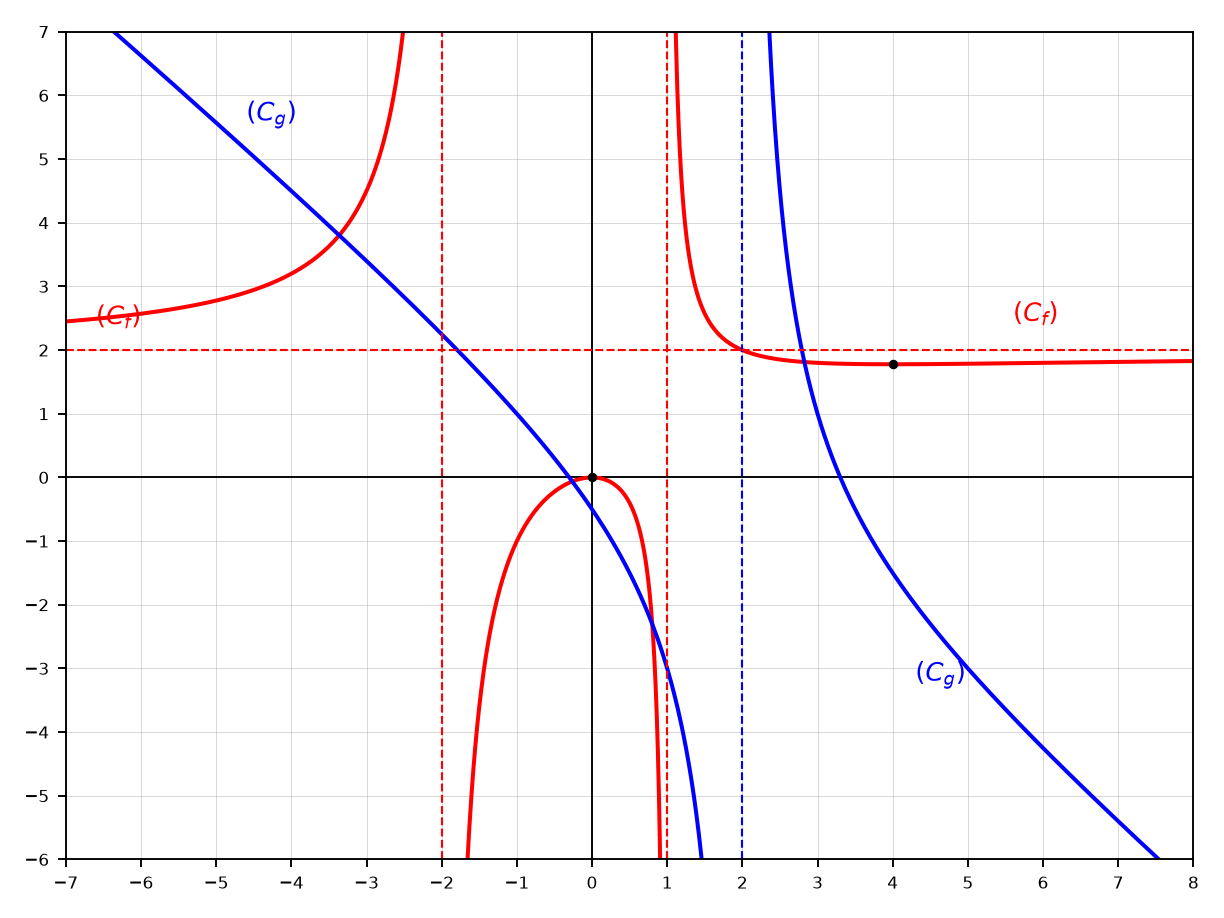
Dans le repère ci-dessous, ( C f ) (C_f) ( C f ) ( C g ) (C_g) ( C g ) f f f g g g R ∖ { − 2 ; 1 } \mathbb{R}\setminus\{-2\,;1\} R ∖ { − 2 ; 1 } R ∖ { 2 } \mathbb{R}\setminus\{2\} R ∖ { 2 }
Déterminer graphiquement lim x → − ∞ f ( x ) \lim\limits_{x\to-\infty}f(x) x → − ∞ lim f ( x ) lim x → + ∞ f ( x ) \lim\limits_{x\to+\infty}f(x) x → + ∞ lim f ( x ) lim x → ( − 2 ) − f ( x ) \lim\limits_{x\to(-2)^-}f(x) x → ( − 2 ) − lim f ( x ) lim x → ( − 2 ) + f ( x ) \lim\limits_{x\to(-2)^+}f(x) x → ( − 2 ) + lim f ( x ) lim x → 1 − f ( x ) \lim\limits_{x\to1^-}f(x) x → 1 − lim f ( x ) lim x → 1 + f ( x ) \lim\limits_{x\to1^+}f(x) x → 1 + lim f ( x )
Dresser le tableau de variations de f f f f ( 0 ) = 0 f(0)=0 f ( 0 ) = 0 f ( 4 ) = 16 9 f(4)=\dfrac{16}9 f ( 4 ) = 9 16
Déterminer graphiquement lim x → − ∞ g ( x ) \lim\limits_{x\to-\infty}g(x) x → − ∞ lim g ( x ) lim x → + ∞ g ( x ) \lim\limits_{x\to+\infty}g(x) x → + ∞ lim g ( x ) lim x → 2 − g ( x ) \lim\limits_{x\to2^-}g(x) x → 2 − lim g ( x ) lim x → 2 + g ( x ) \lim\limits_{x\to2^+}g(x) x → 2 + lim g ( x )
Dresser le tableau de variations de g g g
Voir la solution
1) lim x → − ∞ f ( x ) = 2 \lim\limits_{x\to-\infty}f(x)=2 x → − ∞ lim f ( x ) = 2 lim x → + ∞ f ( x ) = 2 \lim\limits_{x\to+\infty}f(x)=2 x → + ∞ lim f ( x ) = 2 y = 2 y=2 y = 2 lim x → ( − 2 ) − f ( x ) = + ∞ \lim\limits_{x\to(-2)^-}f(x)=+\infty x → ( − 2 ) − lim f ( x ) = + ∞ lim x → ( − 2 ) + f ( x ) = − ∞ \lim\limits_{x\to(-2)^+}f(x)=-\infty x → ( − 2 ) + lim f ( x ) = − ∞ lim x → 1 − f ( x ) = − ∞ \lim\limits_{x\to1^-}f(x)=-\infty x → 1 − lim f ( x ) = − ∞ lim x → 1 + f ( x ) = + ∞ \lim\limits_{x\to1^+}f(x)=+\infty x → 1 + lim f ( x ) = + ∞
2)
x x x − ∞ -\infty − ∞ − 2 -2 − 2 0 0 0 1 1 1 4 4 4 + ∞ +\infty + ∞ f ( x ) f(x) f ( x ) 2 2 2 ↗ \nearrow ↗ + ∞ ∥ − ∞ +\infty\ \Vert\ -\infty + ∞ ∥ − ∞ ↗ \nearrow ↗ 0 0 0 ↘ \searrow ↘ − ∞ ∥ + ∞ -\infty\ \Vert\ +\infty − ∞ ∥ + ∞ ↘ \searrow ↘ 16 9 \frac{16}9 9 16 ↗ \nearrow ↗ 2 2 2
3) lim x → − ∞ g ( x ) = + ∞ \lim\limits_{x\to-\infty}g(x)=+\infty x → − ∞ lim g ( x ) = + ∞ lim x → + ∞ g ( x ) = − ∞ \lim\limits_{x\to+\infty}g(x)=-\infty x → + ∞ lim g ( x ) = − ∞ lim x → 2 − g ( x ) = − ∞ \lim\limits_{x\to2^-}g(x)=-\infty x → 2 − lim g ( x ) = − ∞ lim x → 2 + g ( x ) = + ∞ \lim\limits_{x\to2^+}g(x)=+\infty x → 2 + lim g ( x ) = + ∞
4) g g g ] − ∞ ; 2 [ ]-\infty\,;2[ ] − ∞ ; 2 [ ] 2 ; + ∞ [ ]2\,;+\infty[ ] 2 ; + ∞ [
x x x − ∞ -\infty − ∞ 2 2 2 + ∞ +\infty + ∞ g ( x ) g(x) g ( x ) + ∞ +\infty + ∞ ↘ \searrow ↘ − ∞ ∥ + ∞ -\infty\ \Vert\ +\infty − ∞ ∥ + ∞ ↘ \searrow ↘ − ∞ -\infty − ∞
Série d’exercices
Exercice 1 — Opérations sur les limites Facile ★☆☆☆☆
Calculer les limites suivantes :
1) lim x → 4 ( 2 x 3 − 1 + 2 x ) \lim\limits_{x\to4}\Big(2x^3-1+\dfrac2{\sqrt x}\Big) x → 4 lim ( 2 x 3 − 1 + x 2 ) \quad 2) lim x → 3 + x 2 + x x 2 − x − 6 \lim\limits_{x\to3^+}\dfrac{x^2+x}{x^2-x-6} x → 3 + lim x 2 − x − 6 x 2 + x \quad 3) lim x → 2 + 4 x + 1 x 2 − 5 x + 6 \lim\limits_{x\to2^+}\dfrac{4x+1}{x^2-5x+6} x → 2 + lim x 2 − 5 x + 6 4 x + 1 \quad 4) lim x → 1 + 3 x − 5 1 − x \lim\limits_{x\to1^+}\dfrac{3x-5}{1-x} x → 1 + lim 1 − x 3 x − 5
5) lim x → 0 + 2 − x 2 + 3 x \lim\limits_{x\to0^+}\dfrac2{-x^2+3x} x → 0 + lim − x 2 + 3 x 2 \quad 6) lim x → 3 − 1 x − 3 \lim\limits_{x\to3^-}\dfrac1{x-3} x → 3 − lim x − 3 1 \quad 7) lim x → − ∞ ( 2 − x ) 3 ( − x 2 + 4 x + 1 ) \lim\limits_{x\to-\infty}(2-x)^3(-x^2+4x+1) x → − ∞ lim ( 2 − x ) 3 ( − x 2 + 4 x + 1 ) \quad 8) lim x → 0 − ( 2 x 4 − 3 x 3 ) \lim\limits_{x\to0^-}\Big(\dfrac2{x^4}-\dfrac3{x^3}\Big) x → 0 − lim ( x 4 2 − x 3 3 )
9) lim x → 0 − 2 − 1 x \lim\limits_{x\to0^-}\sqrt{2-\dfrac1x} x → 0 − lim 2 − x 1 \quad 10) lim x → − 3 7 − 3 x \lim\limits_{x\to-3}\sqrt{7-3x} x → − 3 lim 7 − 3 x \quad 11) lim x → 2 + ( 3 x x − 2 − 1 4 − x 2 ) \lim\limits_{x\to2^+}\Big(\dfrac{3x}{x-2}-\dfrac1{4-x^2}\Big) x → 2 + lim ( x − 2 3 x − 4 − x 2 1 )
Voir la solution
1) 2 x 3 − 1 → 2 × 64 − 1 = 127 2x^3-1\to2\times64-1=127 2 x 3 − 1 → 2 × 64 − 1 = 127 2 x → 2 2 = 1 \dfrac2{\sqrt x}\to\dfrac22=1 x 2 → 2 2 = 1 128 128 128
2) x 2 + x → 12 x^2+x\to12 x 2 + x → 12 x 2 − x − 6 = ( x − 3 ) ( x + 2 ) x^2-x-6=(x-3)(x+2) x 2 − x − 6 = ( x − 3 ) ( x + 2 ) x > 3 x>3 x > 3 x 2 − x − 6 → 0 + x^2-x-6\to0^+ x 2 − x − 6 → 0 + 12 0 + \dfrac{12}{0^+} 0 + 12 = + ∞ =+\infty = + ∞
3) 4 x + 1 → 9 4x+1\to9 4 x + 1 → 9 x 2 − 5 x + 6 = ( x − 2 ) ( x − 3 ) x^2-5x+6=(x-2)(x-3) x 2 − 5 x + 6 = ( x − 2 ) ( x − 3 ) 2 < x < 3 2<x<3 2 < x < 3 x − 2 > 0 x-2>0 x − 2 > 0 x − 3 < 0 x-3<0 x − 3 < 0 x 2 − 5 x + 6 → 0 − x^2-5x+6\to0^- x 2 − 5 x + 6 → 0 − 9 0 − \dfrac9{0^-} 0 − 9 = − ∞ =-\infty = − ∞
4) 3 x − 5 → − 2 3x-5\to-2 3 x − 5 → − 2 x > 1 x>1 x > 1 1 − x < 0 1-x<0 1 − x < 0 1 − x → 0 − 1-x\to0^- 1 − x → 0 − − 2 0 − \dfrac{-2}{0^-} 0 − − 2 = + ∞ =+\infty = + ∞
5) − x 2 + 3 x = x ( 3 − x ) -x^2+3x=x(3-x) − x 2 + 3 x = x ( 3 − x ) 0 < x < 3 0<x<3 0 < x < 3 − x 2 + 3 x → 0 + -x^2+3x\to0^+ − x 2 + 3 x → 0 + 2 0 + \dfrac2{0^+} 0 + 2 = + ∞ =+\infty = + ∞
6) Pour x < 3 x<3 x < 3 x − 3 < 0 x-3<0 x − 3 < 0 1 0 − \dfrac1{0^-} 0 − 1 = − ∞ =-\infty = − ∞
7) 2 − x → + ∞ 2-x\to+\infty 2 − x → + ∞ ( 2 − x ) 3 → + ∞ (2-x)^3\to+\infty ( 2 − x ) 3 → + ∞ − x 2 + 4 x + 1 = − x 2 + ( 4 x + 1 ) -x^2+4x+1=-x^2+(4x+1) − x 2 + 4 x + 1 = − x 2 + ( 4 x + 1 ) − x 2 → − ∞ -x^2\to-\infty − x 2 → − ∞ 4 x + 1 → − ∞ 4x+1\to-\infty 4 x + 1 → − ∞ − x 2 + 4 x + 1 → − ∞ -x^2+4x+1\to-\infty − x 2 + 4 x + 1 → − ∞ ( + ∞ ) × ( − ∞ ) (+\infty)\times(-\infty) ( + ∞ ) × ( − ∞ ) = − ∞ =-\infty = − ∞
8) x 4 → 0 + x^4\to0^+ x 4 → 0 + 2 x 4 → + ∞ \dfrac2{x^4}\to+\infty x 4 2 → + ∞ x < 0 x<0 x < 0 x 3 → 0 − x^3\to0^- x 3 → 0 − 3 x 3 → − ∞ \dfrac{3}{x^3}\to-\infty x 3 3 → − ∞ − 3 x 3 → + ∞ -\dfrac3{x^3}\to+\infty − x 3 3 → + ∞ + ∞ +\infty + ∞
9) Pour x < 0 x<0 x < 0 1 x → − ∞ \dfrac1x\to-\infty x 1 → − ∞ 2 − 1 x → + ∞ 2-\dfrac1x\to+\infty 2 − x 1 → + ∞ 2 − 1 x → + ∞ \sqrt{2-\dfrac1x}\to+\infty 2 − x 1 → + ∞
10) 7 − 3 x → 7 + 9 = 16 7-3x\to7+9=16 7 − 3 x → 7 + 9 = 16 7 − 3 x → 16 = 4 \sqrt{7-3x}\to\sqrt{16}=4 7 − 3 x → 16 = 4
11) 3 x → 6 3x\to6 3 x → 6 x − 2 → 0 + x-2\to0^+ x − 2 → 0 + 3 x x − 2 → + ∞ \dfrac{3x}{x-2}\to+\infty x − 2 3 x → + ∞ x > 2 x>2 x > 2 4 − x 2 < 0 4-x^2<0 4 − x 2 < 0 1 4 − x 2 → − ∞ \dfrac1{4-x^2}\to-\infty 4 − x 2 1 → − ∞ − 1 4 − x 2 → + ∞ -\dfrac1{4-x^2}\to+\infty − 4 − x 2 1 → + ∞ + ∞ +\infty + ∞
Exercice 2 — Limite à gauche, limite à droite Facile ★★☆☆☆
Soit a a a f f f R ∖ { − 2 } \mathbb{R}\setminus\{-2\} R ∖ { − 2 } f ( x ) = x 2 + 5 x + 2 si x ≤ 1 et f ( x ) = 3 − a x 2 si x > 1. f(x)=\frac{x^2+5}{x+2}\ \text{ si } x\le1\qquad\text{et}\qquad f(x)=3-ax^2\ \text{ si } x>1. f ( x ) = x + 2 x 2 + 5 si x ≤ 1 et f ( x ) = 3 − a x 2 si x > 1. f ( 1 ) f(1) f ( 1 ) a a a lim x → 1 f ( x ) = f ( 1 ) \lim\limits_{x\to1}f(x)=f(1) x → 1 lim f ( x ) = f ( 1 )
Voir la solution
1) 1 ≤ 1 1\le1 1 ≤ 1 f ( 1 ) = 1 + 5 1 + 2 = 6 3 = 2 f(1)=\dfrac{1+5}{1+2}=\dfrac63=2 f ( 1 ) = 1 + 2 1 + 5 = 3 6 = 2
À gauche de 1 1 1 lim x → 1 − f ( x ) = lim x → 1 − x 2 + 5 x + 2 = 6 3 = 2 \lim\limits_{x\to1^-}f(x)=\lim\limits_{x\to1^-}\dfrac{x^2+5}{x+2}=\dfrac63=2 x → 1 − lim f ( x ) = x → 1 − lim x + 2 x 2 + 5 = 3 6 = 2
À droite de 1 1 1 lim x → 1 + f ( x ) = lim x → 1 + ( 3 − a x 2 ) = 3 − a \lim\limits_{x\to1^+}f(x)=\lim\limits_{x\to1^+}(3-ax^2)=3-a x → 1 + lim f ( x ) = x → 1 + lim ( 3 − a x 2 ) = 3 − a
On a lim x → 1 f ( x ) = f ( 1 ) \lim\limits_{x\to1}f(x)=f(1) x → 1 lim f ( x ) = f ( 1 ) 1 1 1 f ( 1 ) = 2 f(1)=2 f ( 1 ) = 2 3 − a = 2 3-a=2 3 − a = 2 a = 1 a=1 a = 1
Pour a = 1 a=1 a = 1 lim x → 1 f ( x ) = 2 = f ( 1 ) \lim\limits_{x\to1}f(x)=2=f(1) x → 1 lim f ( x ) = 2 = f ( 1 )
Calculer les limites suivantes :
1) lim x → 2 x 3 − 8 x − 2 \lim\limits_{x\to2}\dfrac{x^3-8}{x-2} x → 2 lim x − 2 x 3 − 8 \quad 2) lim x → − 3 x 3 + 27 x + 3 \lim\limits_{x\to-3}\dfrac{x^3+27}{x+3} x → − 3 lim x + 3 x 3 + 27 \quad 3) lim x → 0 ( 3 + x ) 2 − 9 x \lim\limits_{x\to0}\dfrac{(3+x)^2-9}{x} x → 0 lim x ( 3 + x ) 2 − 9 \quad 4) lim x → 3 x 2 − 3 x x 2 − 9 \lim\limits_{x\to3}\dfrac{x^2-3x}{x^2-9} x → 3 lim x 2 − 9 x 2 − 3 x
5) lim x → − 1 x 2 + x x 2 − 1 \lim\limits_{x\to-1}\dfrac{x^2+x}{x^2-1} x → − 1 lim x 2 − 1 x 2 + x \quad 6) lim x → 1 x 2 + 2 x − 3 2 x 2 − x − 1 \lim\limits_{x\to1}\dfrac{x^2+2x-3}{2x^2-x-1} x → 1 lim 2 x 2 − x − 1 x 2 + 2 x − 3 \quad 7) lim x → 1 x 3 − 1 x 4 − 1 \lim\limits_{x\to1}\dfrac{x^3-1}{x^4-1} x → 1 lim x 4 − 1 x 3 − 1 \quad 8) lim x → 16 x − 16 x − 4 \lim\limits_{x\to16}\dfrac{x-16}{\sqrt x-4} x → 16 lim x − 4 x − 16
9) lim x → 2 x 2 − 4 x − 2 \lim\limits_{x\to2}\dfrac{x^2-4}{\sqrt x-\sqrt2} x → 2 lim x − 2 x 2 − 4 \quad 10) lim x → 3 x − 3 x x − 3 \lim\limits_{x\to3}\dfrac{x-\sqrt{3x}}{x-3} x → 3 lim x − 3 x − 3 x \quad 11) lim x → 3 x − 3 x 2 − 3 x \lim\limits_{x\to3}\dfrac{\sqrt x-\sqrt3}{x^2-3x} x → 3 lim x 2 − 3 x x − 3 \quad 12) lim x → + ∞ ( 3 x − x ) \lim\limits_{x\to+\infty}(3x-\sqrt x) x → + ∞ lim ( 3 x − x )
13) lim x → 0 + ( 1 x − 1 x 2 ) \lim\limits_{x\to0^+}\Big(\dfrac1x-\dfrac1{x^2}\Big) x → 0 + lim ( x 1 − x 2 1 ) \quad 14) lim x → 0 ( x + 1 ) 3 + ( x − 1 ) 2 − 2 x \lim\limits_{x\to0}\dfrac{(x+1)^3+(x-1)^2-2}{x} x → 0 lim x ( x + 1 ) 3 + ( x − 1 ) 2 − 2 \quad 15) lim x → 1 + x 2 + 2 x − 3 ( x − 1 ) 2 \lim\limits_{x\to1^+}\dfrac{x^2+2x-3}{(x-1)^2} x → 1 + lim ( x − 1 ) 2 x 2 + 2 x − 3
16) lim x → − 2 + 3 x 2 + 5 x − 2 x 3 + 2 x 2 − x − 2 \lim\limits_{x\to-2^+}\dfrac{3x^2+5x-2}{x^3+2x^2-x-2} x → − 2 + lim x 3 + 2 x 2 − x − 2 3 x 2 + 5 x − 2 \quad 17) lim x → 2 − x 2 + x − 6 x 3 − 3 x 2 + 4 \lim\limits_{x\to2^-}\dfrac{x^2+x-6}{x^3-3x^2+4} x → 2 − lim x 3 − 3 x 2 + 4 x 2 + x − 6 \quad 18) lim x → 1 − x 3 + 3 x 2 − x − 1 − x 2 + 4 x − 3 \lim\limits_{x\to1}\dfrac{-x^3+3x^2-x-1}{-x^2+4x-3} x → 1 lim − x 2 + 4 x − 3 − x 3 + 3 x 2 − x − 1
19) lim x → + ∞ ( 3 x + 1 − 2 x 2 + x + 5 ) \lim\limits_{x\to+\infty}\big(\sqrt{3x+1}-2x^2+x+5\big) x → + ∞ lim ( 3 x + 1 − 2 x 2 + x + 5 ) \quad 20) lim x → + ∞ ( x + 3 + x 3 − 2 x ) \lim\limits_{x\to+\infty}\big(\sqrt{x+3}+x^3-2x\big) x → + ∞ lim ( x + 3 + x 3 − 2 x )
Voir la solution
Les limites 1) à 11) et 13) à 18) sont des formes indéterminées : on factorise, puis on simplifie.
1) x 3 − 8 = ( x − 2 ) ( x 2 + 2 x + 4 ) x^3-8=(x-2)(x^2+2x+4) x 3 − 8 = ( x − 2 ) ( x 2 + 2 x + 4 ) x 3 − 8 x − 2 = x 2 + 2 x + 4 → 4 + 4 + 4 = 12 \dfrac{x^3-8}{x-2}=x^2+2x+4\to4+4+4=12 x − 2 x 3 − 8 = x 2 + 2 x + 4 → 4 + 4 + 4 = 12
2) x 3 + 27 = x 3 + 3 3 = ( x + 3 ) ( x 2 − 3 x + 9 ) x^3+27=x^3+3^3=(x+3)(x^2-3x+9) x 3 + 27 = x 3 + 3 3 = ( x + 3 ) ( x 2 − 3 x + 9 ) x 3 + 27 x + 3 = x 2 − 3 x + 9 → 9 + 9 + 9 = 27 \dfrac{x^3+27}{x+3}=x^2-3x+9\to9+9+9=27 x + 3 x 3 + 27 = x 2 − 3 x + 9 → 9 + 9 + 9 = 27
3) ( 3 + x ) 2 − 9 = x 2 + 6 x = x ( x + 6 ) (3+x)^2-9=x^2+6x=x(x+6) ( 3 + x ) 2 − 9 = x 2 + 6 x = x ( x + 6 ) ( 3 + x ) 2 − 9 x = x + 6 → 6 \dfrac{(3+x)^2-9}{x}=x+6\to6 x ( 3 + x ) 2 − 9 = x + 6 → 6
4) x 2 − 3 x x 2 − 9 = x ( x − 3 ) ( x − 3 ) ( x + 3 ) = x x + 3 → 3 6 = 1 2 \dfrac{x^2-3x}{x^2-9}=\dfrac{x(x-3)}{(x-3)(x+3)}=\dfrac{x}{x+3}\to\dfrac36=\dfrac12 x 2 − 9 x 2 − 3 x = ( x − 3 ) ( x + 3 ) x ( x − 3 ) = x + 3 x → 6 3 = 2 1
5) x 2 + x x 2 − 1 = x ( x + 1 ) ( x − 1 ) ( x + 1 ) = x x − 1 → − 1 − 2 = 1 2 \dfrac{x^2+x}{x^2-1}=\dfrac{x(x+1)}{(x-1)(x+1)}=\dfrac{x}{x-1}\to\dfrac{-1}{-2}=\dfrac12 x 2 − 1 x 2 + x = ( x − 1 ) ( x + 1 ) x ( x + 1 ) = x − 1 x → − 2 − 1 = 2 1
6) 1 1 1 x 2 + 2 x − 3 = ( x − 1 ) ( x + 3 ) x^2+2x-3=(x-1)(x+3) x 2 + 2 x − 3 = ( x − 1 ) ( x + 3 ) 2 x 2 − x − 1 = ( x − 1 ) ( 2 x + 1 ) 2x^2-x-1=(x-1)(2x+1) 2 x 2 − x − 1 = ( x − 1 ) ( 2 x + 1 ) x 2 + 2 x − 3 2 x 2 − x − 1 = x + 3 2 x + 1 → 4 3 \dfrac{x^2+2x-3}{2x^2-x-1}=\dfrac{x+3}{2x+1}\to\dfrac43 2 x 2 − x − 1 x 2 + 2 x − 3 = 2 x + 1 x + 3 → 3 4
7) x 3 − 1 = ( x − 1 ) ( x 2 + x + 1 ) x^3-1=(x-1)(x^2+x+1) x 3 − 1 = ( x − 1 ) ( x 2 + x + 1 ) x 4 − 1 = ( x 2 − 1 ) ( x 2 + 1 ) = ( x − 1 ) ( x + 1 ) ( x 2 + 1 ) x^4-1=(x^2-1)(x^2+1)=(x-1)(x+1)(x^2+1) x 4 − 1 = ( x 2 − 1 ) ( x 2 + 1 ) = ( x − 1 ) ( x + 1 ) ( x 2 + 1 ) x 3 − 1 x 4 − 1 = x 2 + x + 1 ( x + 1 ) ( x 2 + 1 ) → 3 2 × 2 = 3 4 \dfrac{x^3-1}{x^4-1}=\dfrac{x^2+x+1}{(x+1)(x^2+1)}\to\dfrac3{2\times2}=\dfrac34 x 4 − 1 x 3 − 1 = ( x + 1 ) ( x 2 + 1 ) x 2 + x + 1 → 2 × 2 3 = 4 3
8) Pour x ≥ 0 x\ge0 x ≥ 0 x − 16 = ( x − 4 ) ( x + 4 ) x-16=(\sqrt x-4)(\sqrt x+4) x − 16 = ( x − 4 ) ( x + 4 ) x − 16 x − 4 = x + 4 → 8 \dfrac{x-16}{\sqrt x-4}=\sqrt x+4\to8 x − 4 x − 16 = x + 4 → 8
9) Pour x > 0 x>0 x > 0 x 2 − 4 = ( x − 2 ) ( x + 2 ) = ( x − 2 ) ( x + 2 ) ( x + 2 ) x^2-4=(x-2)(x+2)=(\sqrt x-\sqrt2)(\sqrt x+\sqrt2)(x+2) x 2 − 4 = ( x − 2 ) ( x + 2 ) = ( x − 2 ) ( x + 2 ) ( x + 2 ) x 2 − 4 x − 2 = ( x + 2 ) ( x + 2 ) → 2 2 × 4 = 8 2 \dfrac{x^2-4}{\sqrt x-\sqrt2}=(\sqrt x+\sqrt2)(x+2)\to2\sqrt2\times4=8\sqrt2 x − 2 x 2 − 4 = ( x + 2 ) ( x + 2 ) → 2 2 × 4 = 8 2
10) On multiplie par la conjuguée x + 3 x x+\sqrt{3x} x + 3 x x − 3 x x − 3 = x 2 − 3 x ( x − 3 ) ( x + 3 x ) = x x + 3 x → 3 3 + 3 = 1 2 \dfrac{x-\sqrt{3x}}{x-3}=\dfrac{x^2-3x}{(x-3)(x+\sqrt{3x})}=\dfrac{x}{x+\sqrt{3x}}\to\dfrac3{3+3}=\dfrac12 x − 3 x − 3 x = ( x − 3 ) ( x + 3 x ) x 2 − 3 x = x + 3 x x → 3 + 3 3 = 2 1
11) x − 3 x 2 − 3 x = x − 3 x ( x − 3 ) ( x + 3 ) = 1 x ( x + 3 ) → 1 3 × 2 3 = 1 6 3 = 3 18 \dfrac{\sqrt x-\sqrt3}{x^2-3x}=\dfrac{x-3}{x(x-3)(\sqrt x+\sqrt3)}=\dfrac1{x(\sqrt x+\sqrt3)}\to\dfrac1{3\times2\sqrt3}=\dfrac{1}{6\sqrt3}=\dfrac{\sqrt3}{18} x 2 − 3 x x − 3 = x ( x − 3 ) ( x + 3 ) x − 3 = x ( x + 3 ) 1 → 3 × 2 3 1 = 6 3 1 = 18 3
12) Forme « + ∞ − ∞ +\infty-\infty + ∞ − ∞ x > 0 x>0 x > 0 3 x − x = x ( 3 x − 1 ) 3x-\sqrt x=\sqrt x\,(3\sqrt x-1) 3 x − x = x ( 3 x − 1 ) + ∞ +\infty + ∞ + ∞ +\infty + ∞
13) Forme « + ∞ − ∞ +\infty-\infty + ∞ − ∞ 1 x − 1 x 2 = x − 1 x 2 \dfrac1x-\dfrac1{x^2}=\dfrac{x-1}{x^2} x 1 − x 2 1 = x 2 x − 1 x − 1 → − 1 x-1\to-1 x − 1 → − 1 x 2 → 0 + x^2\to0^+ x 2 → 0 + − ∞ -\infty − ∞
14) On développe : ( x + 1 ) 3 + ( x − 1 ) 2 − 2 = x 3 + 3 x 2 + 3 x + 1 + x 2 − 2 x + 1 − 2 = x 3 + 4 x 2 + x (x+1)^3+(x-1)^2-2=x^3+3x^2+3x+1+x^2-2x+1-2=x^3+4x^2+x ( x + 1 ) 3 + ( x − 1 ) 2 − 2 = x 3 + 3 x 2 + 3 x + 1 + x 2 − 2 x + 1 − 2 = x 3 + 4 x 2 + x x ≠ 0 x\neq0 x = 0 x 3 + 4 x 2 + x x = x 2 + 4 x + 1 → 1 \dfrac{x^3+4x^2+x}{x}=x^2+4x+1\to1 x x 3 + 4 x 2 + x = x 2 + 4 x + 1 → 1
15) x 2 + 2 x − 3 ( x − 1 ) 2 = ( x − 1 ) ( x + 3 ) ( x − 1 ) 2 = x + 3 x − 1 \dfrac{x^2+2x-3}{(x-1)^2}=\dfrac{(x-1)(x+3)}{(x-1)^2}=\dfrac{x+3}{x-1} ( x − 1 ) 2 x 2 + 2 x − 3 = ( x − 1 ) 2 ( x − 1 ) ( x + 3 ) = x − 1 x + 3 x + 3 → 4 x+3\to4 x + 3 → 4 x − 1 → 0 + x-1\to0^+ x − 1 → 0 + + ∞ +\infty + ∞
16) En − 2 -2 − 2 3 × 4 − 10 − 2 = 0 3\times4-10-2=0 3 × 4 − 10 − 2 = 0 − 8 + 8 + 2 − 2 = 0 -8+8+2-2=0 − 8 + 8 + 2 − 2 = 0 3 x 2 + 5 x − 2 = ( x + 2 ) ( 3 x − 1 ) 3x^2+5x-2=(x+2)(3x-1) 3 x 2 + 5 x − 2 = ( x + 2 ) ( 3 x − 1 ) x 3 + 2 x 2 − x − 2 = x 2 ( x + 2 ) − ( x + 2 ) = ( x + 2 ) ( x 2 − 1 ) x^3+2x^2-x-2=x^2(x+2)-(x+2)=(x+2)(x^2-1) x 3 + 2 x 2 − x − 2 = x 2 ( x + 2 ) − ( x + 2 ) = ( x + 2 ) ( x 2 − 1 ) 3 x 2 + 5 x − 2 x 3 + 2 x 2 − x − 2 = 3 x − 1 x 2 − 1 → − 7 3 \dfrac{3x^2+5x-2}{x^3+2x^2-x-2}=\dfrac{3x-1}{x^2-1}\to\dfrac{-7}{3} x 3 + 2 x 2 − x − 2 3 x 2 + 5 x − 2 = x 2 − 1 3 x − 1 → 3 − 7
17) x 2 + x − 6 = ( x − 2 ) ( x + 3 ) x^2+x-6=(x-2)(x+3) x 2 + x − 6 = ( x − 2 ) ( x + 3 ) x 3 − 3 x 2 + 4 x^3-3x^2+4 x 3 − 3 x 2 + 4 x − 2 x-2 x − 2 x 2 − x − 2 = ( x − 2 ) ( x + 1 ) x^2-x-2=(x-2)(x+1) x 2 − x − 2 = ( x − 2 ) ( x + 1 ) x 3 − 3 x 2 + 4 = ( x − 2 ) 2 ( x + 1 ) x^3-3x^2+4=(x-2)^2(x+1) x 3 − 3 x 2 + 4 = ( x − 2 ) 2 ( x + 1 ) x 2 + x − 6 x 3 − 3 x 2 + 4 = x + 3 ( x − 2 ) ( x + 1 ) \dfrac{x^2+x-6}{x^3-3x^2+4}=\dfrac{x+3}{(x-2)(x+1)} x 3 − 3 x 2 + 4 x 2 + x − 6 = ( x − 2 ) ( x + 1 ) x + 3 x + 3 → 5 x+3\to5 x + 3 → 5 x + 1 → 3 x+1\to3 x + 1 → 3 x − 2 → 0 − x-2\to0^- x − 2 → 0 − − ∞ -\infty − ∞
18) En 1 1 1 − 1 + 3 − 1 − 1 = 0 -1+3-1-1=0 − 1 + 3 − 1 − 1 = 0 − 1 + 4 − 3 = 0 -1+4-3=0 − 1 + 4 − 3 = 0 − x 3 + 3 x 2 − x − 1 = ( x − 1 ) ( − x 2 + 2 x + 1 ) -x^3+3x^2-x-1=(x-1)(-x^2+2x+1) − x 3 + 3 x 2 − x − 1 = ( x − 1 ) ( − x 2 + 2 x + 1 ) − x 2 + 4 x − 3 = ( x − 1 ) ( − x + 3 ) -x^2+4x-3=(x-1)(-x+3) − x 2 + 4 x − 3 = ( x − 1 ) ( − x + 3 ) − x 3 + 3 x 2 − x − 1 − x 2 + 4 x − 3 = − x 2 + 2 x + 1 − x + 3 → 2 2 = 1 \dfrac{-x^3+3x^2-x-1}{-x^2+4x-3}=\dfrac{-x^2+2x+1}{-x+3}\to\dfrac{2}{2}=1 − x 2 + 4 x − 3 − x 3 + 3 x 2 − x − 1 = − x + 3 − x 2 + 2 x + 1 → 2 2 = 1
19) Forme « + ∞ − ∞ +\infty-\infty + ∞ − ∞ x > 0 x>0 x > 0 3 x + 1 − 2 x 2 + x + 5 = x 2 ( 3 x + 1 x 2 − 2 + 1 x + 5 x 2 ) \sqrt{3x+1}-2x^2+x+5=x^2\Big(\dfrac{\sqrt{3x+1}}{x^2}-2+\dfrac1x+\dfrac5{x^2}\Big) 3 x + 1 − 2 x 2 + x + 5 = x 2 ( x 2 3 x + 1 − 2 + x 1 + x 2 5 ) 3 x + 1 x 2 = 1 x 3 x + 1 x 2 = 1 x 3 x + 1 x 2 → 0 \dfrac{\sqrt{3x+1}}{x^2}=\dfrac{1}{x}\sqrt{\dfrac{3x+1}{x^2}}=\dfrac1x\sqrt{\dfrac3x+\dfrac1{x^2}}\to0 x 2 3 x + 1 = x 1 x 2 3 x + 1 = x 1 x 3 + x 2 1 → 0 − 2 -2 − 2 x 2 → + ∞ x^2\to+\infty x 2 → + ∞ − ∞ -\infty − ∞
20) x 3 − 2 x = x ( x 2 − 2 ) → + ∞ x^3-2x=x(x^2-2)\to+\infty x 3 − 2 x = x ( x 2 − 2 ) → + ∞ x + 3 → + ∞ \sqrt{x+3}\to+\infty x + 3 → + ∞ + ∞ +\infty + ∞
Calculer les limites suivantes :
1) lim x → 1 x + 8 − 3 x − 1 \lim\limits_{x\to1}\dfrac{\sqrt{x+8}-3}{x-1} x → 1 lim x − 1 x + 8 − 3 \quad 2) lim x → 0 4 + x − 4 − x x \lim\limits_{x\to0}\dfrac{\sqrt{4+x}-\sqrt{4-x}}{x} x → 0 lim x 4 + x − 4 − x \quad 3) lim x → 2 3 x + 3 − 3 x − 2 \lim\limits_{x\to2}\dfrac{\sqrt{3x+3}-3}{x-2} x → 2 lim x − 2 3 x + 3 − 3
4) lim x → − 2 x 2 + 5 − 3 x 2 + 2 x \lim\limits_{x\to-2}\dfrac{\sqrt{x^2+5}-3}{x^2+2x} x → − 2 lim x 2 + 2 x x 2 + 5 − 3 \quad 5) lim x → 4 x − 4 x 2 + 9 − 5 \lim\limits_{x\to4}\dfrac{x-4}{\sqrt{x^2+9}-5} x → 4 lim x 2 + 9 − 5 x − 4 \quad 6) lim x → 0 x + 9 − 3 x 2 + x \lim\limits_{x\to0}\dfrac{\sqrt{x+9}-3}{x^2+x} x → 0 lim x 2 + x x + 9 − 3
7) lim x → 0 2 x + 1 − x + 1 x + 4 − 2 \lim\limits_{x\to0}\dfrac{\sqrt{2x+1}-\sqrt{x+1}}{\sqrt{x+4}-2} x → 0 lim x + 4 − 2 2 x + 1 − x + 1 \quad 8) lim x → 2 x + 7 − 3 3 x − 2 − x \lim\limits_{x\to2}\dfrac{\sqrt{x+7}-3}{\sqrt{3x-2}-x} x → 2 lim 3 x − 2 − x x + 7 − 3 \quad 9) lim x → 2 3 x − 2 − x 2 − x + 2 x − 2 \lim\limits_{x\to2}\dfrac{\sqrt{3x-2}-\sqrt{x^2-x+2}}{\sqrt x-\sqrt2} x → 2 lim x − 2 3 x − 2 − x 2 − x + 2
10) lim x → − 2 x 2 − 4 1 − 4 x − 3 \lim\limits_{x\to-2}\dfrac{x^2-4}{\sqrt{1-4x}-3} x → − 2 lim 1 − 4 x − 3 x 2 − 4 \quad 11) lim x → 2 + x 2 − 4 + 2 x − 4 x − 2 \lim\limits_{x\to2^+}\dfrac{\sqrt{x^2-4}+\sqrt{2x-4}}{\sqrt{x-2}} x → 2 + lim x − 2 x 2 − 4 + 2 x − 4 \quad 12) lim x → 1 x + 3 − x − 1 x + 8 − x − 2 \lim\limits_{x\to1}\dfrac{\sqrt{x+3}-\sqrt x-1}{\sqrt{x+8}-\sqrt x-2} x → 1 lim x + 8 − x − 2 x + 3 − x − 1
Voir la solution
Toutes ces limites sont de la forme « 0 0 \dfrac00 0 0
1) x + 8 − 3 x − 1 = x + 8 − 9 ( x − 1 ) ( x + 8 + 3 ) = 1 x + 8 + 3 → 1 6 \dfrac{\sqrt{x+8}-3}{x-1}=\dfrac{x+8-9}{(x-1)(\sqrt{x+8}+3)}=\dfrac1{\sqrt{x+8}+3}\to\dfrac16 x − 1 x + 8 − 3 = ( x − 1 ) ( x + 8 + 3 ) x + 8 − 9 = x + 8 + 3 1 → 6 1
2) 4 + x − 4 − x x = ( 4 + x ) − ( 4 − x ) x ( 4 + x + 4 − x ) = 2 4 + x + 4 − x → 2 4 = 1 2 \dfrac{\sqrt{4+x}-\sqrt{4-x}}{x}=\dfrac{(4+x)-(4-x)}{x(\sqrt{4+x}+\sqrt{4-x})}=\dfrac2{\sqrt{4+x}+\sqrt{4-x}}\to\dfrac24=\dfrac12 x 4 + x − 4 − x = x ( 4 + x + 4 − x ) ( 4 + x ) − ( 4 − x ) = 4 + x + 4 − x 2 → 4 2 = 2 1
3) 3 x + 3 − 3 x − 2 = 3 x + 3 − 9 ( x − 2 ) ( 3 x + 3 + 3 ) = 3 3 x + 3 + 3 → 3 6 = 1 2 \dfrac{\sqrt{3x+3}-3}{x-2}=\dfrac{3x+3-9}{(x-2)(\sqrt{3x+3}+3)}=\dfrac{3}{\sqrt{3x+3}+3}\to\dfrac36=\dfrac12 x − 2 3 x + 3 − 3 = ( x − 2 ) ( 3 x + 3 + 3 ) 3 x + 3 − 9 = 3 x + 3 + 3 3 → 6 3 = 2 1
4) x 2 + 5 − 3 x 2 + 2 x = x 2 − 4 x ( x + 2 ) ( x 2 + 5 + 3 ) = x − 2 x ( x 2 + 5 + 3 ) → − 4 − 2 × 6 = 1 3 \dfrac{\sqrt{x^2+5}-3}{x^2+2x}=\dfrac{x^2-4}{x(x+2)(\sqrt{x^2+5}+3)}=\dfrac{x-2}{x(\sqrt{x^2+5}+3)}\to\dfrac{-4}{-2\times6}=\dfrac13 x 2 + 2 x x 2 + 5 − 3 = x ( x + 2 ) ( x 2 + 5 + 3 ) x 2 − 4 = x ( x 2 + 5 + 3 ) x − 2 → − 2 × 6 − 4 = 3 1
5) x − 4 x 2 + 9 − 5 = ( x − 4 ) ( x 2 + 9 + 5 ) x 2 − 16 = x 2 + 9 + 5 x + 4 → 10 8 = 5 4 \dfrac{x-4}{\sqrt{x^2+9}-5}=\dfrac{(x-4)(\sqrt{x^2+9}+5)}{x^2-16}=\dfrac{\sqrt{x^2+9}+5}{x+4}\to\dfrac{10}8=\dfrac54 x 2 + 9 − 5 x − 4 = x 2 − 16 ( x − 4 ) ( x 2 + 9 + 5 ) = x + 4 x 2 + 9 + 5 → 8 10 = 4 5
6) x + 9 − 3 x 2 + x = x x ( x + 1 ) ( x + 9 + 3 ) = 1 ( x + 1 ) ( x + 9 + 3 ) → 1 6 \dfrac{\sqrt{x+9}-3}{x^2+x}=\dfrac{x}{x(x+1)(\sqrt{x+9}+3)}=\dfrac1{(x+1)(\sqrt{x+9}+3)}\to\dfrac16 x 2 + x x + 9 − 3 = x ( x + 1 ) ( x + 9 + 3 ) x = ( x + 1 ) ( x + 9 + 3 ) 1 → 6 1
7) Numérateur : 2 x + 1 − x + 1 = x 2 x + 1 + x + 1 \sqrt{2x+1}-\sqrt{x+1}=\dfrac{x}{\sqrt{2x+1}+\sqrt{x+1}} 2 x + 1 − x + 1 = 2 x + 1 + x + 1 x x + 4 − 2 = x x + 4 + 2 \sqrt{x+4}-2=\dfrac{x}{\sqrt{x+4}+2} x + 4 − 2 = x + 4 + 2 x x ≠ 0 x\neq0 x = 0 2 x + 1 − x + 1 x + 4 − 2 = x + 4 + 2 2 x + 1 + x + 1 → 4 2 = 2 \dfrac{\sqrt{2x+1}-\sqrt{x+1}}{\sqrt{x+4}-2}=\dfrac{\sqrt{x+4}+2}{\sqrt{2x+1}+\sqrt{x+1}}\to\dfrac42=2 x + 4 − 2 2 x + 1 − x + 1 = 2 x + 1 + x + 1 x + 4 + 2 → 2 4 = 2
8) Numérateur : x + 7 − 3 = x − 2 x + 7 + 3 \sqrt{x+7}-3=\dfrac{x-2}{\sqrt{x+7}+3} x + 7 − 3 = x + 7 + 3 x − 2 3 x − 2 − x = 3 x − 2 − x 2 3 x − 2 + x = − ( x − 1 ) ( x − 2 ) 3 x − 2 + x \sqrt{3x-2}-x=\dfrac{3x-2-x^2}{\sqrt{3x-2}+x}=\dfrac{-(x-1)(x-2)}{\sqrt{3x-2}+x} 3 x − 2 − x = 3 x − 2 + x 3 x − 2 − x 2 = 3 x − 2 + x − ( x − 1 ) ( x − 2 ) x + 7 − 3 3 x − 2 − x = − 3 x − 2 + x ( x − 1 ) ( x + 7 + 3 ) → − 4 1 × 6 = − 2 3 \dfrac{\sqrt{x+7}-3}{\sqrt{3x-2}-x}=-\dfrac{\sqrt{3x-2}+x}{(x-1)(\sqrt{x+7}+3)}\to-\dfrac{4}{1\times6}=-\dfrac23 3 x − 2 − x x + 7 − 3 = − ( x − 1 ) ( x + 7 + 3 ) 3 x − 2 + x → − 1 × 6 4 = − 3 2
9) Numérateur : 3 x − 2 − x 2 − x + 2 = 3 x − 2 − x 2 + x − 2 3 x − 2 + x 2 − x + 2 = − ( x − 2 ) 2 3 x − 2 + x 2 − x + 2 \sqrt{3x-2}-\sqrt{x^2-x+2}=\dfrac{3x-2-x^2+x-2}{\sqrt{3x-2}+\sqrt{x^2-x+2}}=\dfrac{-(x-2)^2}{\sqrt{3x-2}+\sqrt{x^2-x+2}} 3 x − 2 − x 2 − x + 2 = 3 x − 2 + x 2 − x + 2 3 x − 2 − x 2 + x − 2 = 3 x − 2 + x 2 − x + 2 − ( x − 2 ) 2 x − 2 = x − 2 x + 2 \sqrt x-\sqrt2=\dfrac{x-2}{\sqrt x+\sqrt2} x − 2 = x + 2 x − 2 − ( x − 2 ) ( x + 2 ) 3 x − 2 + x 2 − x + 2 → 0 4 = 0 \dfrac{-(x-2)(\sqrt x+\sqrt2)}{\sqrt{3x-2}+\sqrt{x^2-x+2}}\to\dfrac{0}{4}=0 3 x − 2 + x 2 − x + 2 − ( x − 2 ) ( x + 2 ) → 4 0 = 0
10) 1 − 4 x − 3 = 1 − 4 x − 9 1 − 4 x + 3 = − 4 ( x + 2 ) 1 − 4 x + 3 \sqrt{1-4x}-3=\dfrac{1-4x-9}{\sqrt{1-4x}+3}=\dfrac{-4(x+2)}{\sqrt{1-4x}+3} 1 − 4 x − 3 = 1 − 4 x + 3 1 − 4 x − 9 = 1 − 4 x + 3 − 4 ( x + 2 ) x 2 − 4 1 − 4 x − 3 = ( x − 2 ) ( 1 − 4 x + 3 ) − 4 → − 4 × 6 − 4 = 6 \dfrac{x^2-4}{\sqrt{1-4x}-3}=\dfrac{(x-2)(\sqrt{1-4x}+3)}{-4}\to\dfrac{-4\times6}{-4}=6 1 − 4 x − 3 x 2 − 4 = − 4 ( x − 2 ) ( 1 − 4 x + 3 ) → − 4 − 4 × 6 = 6
11) Pour x > 2 x>2 x > 2 x 2 − 4 = x + 2 x − 2 \sqrt{x^2-4}=\sqrt{x+2}\,\sqrt{x-2} x 2 − 4 = x + 2 x − 2 2 x − 4 = 2 x − 2 \sqrt{2x-4}=\sqrt2\,\sqrt{x-2} 2 x − 4 = 2 x − 2 x − 2 \sqrt{x-2} x − 2 x 2 − 4 + 2 x − 4 x − 2 = x + 2 + 2 → 2 + 2 \dfrac{\sqrt{x^2-4}+\sqrt{2x-4}}{\sqrt{x-2}}=\sqrt{x+2}+\sqrt2\to2+\sqrt2 x − 2 x 2 − 4 + 2 x − 4 = x + 2 + 2 → 2 + 2
12) On écrit x + 3 − x − 1 = ( x + 3 − 2 ) − ( x − 1 ) = x − 1 x + 3 + 2 − x − 1 x + 1 \sqrt{x+3}-\sqrt x-1=(\sqrt{x+3}-2)-(\sqrt x-1)=\dfrac{x-1}{\sqrt{x+3}+2}-\dfrac{x-1}{\sqrt x+1} x + 3 − x − 1 = ( x + 3 − 2 ) − ( x − 1 ) = x + 3 + 2 x − 1 − x + 1 x − 1 x + 8 − x − 2 = ( x + 8 − 3 ) − ( x − 1 ) = x − 1 x + 8 + 3 − x − 1 x + 1 \sqrt{x+8}-\sqrt x-2=(\sqrt{x+8}-3)-(\sqrt x-1)=\dfrac{x-1}{\sqrt{x+8}+3}-\dfrac{x-1}{\sqrt x+1} x + 8 − x − 2 = ( x + 8 − 3 ) − ( x − 1 ) = x + 8 + 3 x − 1 − x + 1 x − 1 x − 1 x-1 x − 1 1 x + 3 + 2 − 1 x + 1 1 x + 8 + 3 − 1 x + 1 → 1 4 − 1 2 1 6 − 1 2 = − 1 4 − 1 3 = 3 4 \dfrac{\frac1{\sqrt{x+3}+2}-\frac1{\sqrt x+1}}{\frac1{\sqrt{x+8}+3}-\frac1{\sqrt x+1}}\to\dfrac{\frac14-\frac12}{\frac16-\frac12}=\dfrac{-\frac14}{-\frac13}=\dfrac34 x + 8 + 3 1 − x + 1 1 x + 3 + 2 1 − x + 1 1 → 6 1 − 2 1 4 1 − 2 1 = − 3 1 − 4 1 = 4 3
Calculer les limites suivantes :
1) lim x → − ∞ x 2 − 5 x + 1 \lim\limits_{x\to-\infty}\sqrt{x^2-5x+1} x → − ∞ lim x 2 − 5 x + 1 \quad 2) lim x → + ∞ ( x − x 2 + 3 ) \lim\limits_{x\to+\infty}\big(x-\sqrt{x^2+3}\big) x → + ∞ lim ( x − x 2 + 3 ) \quad 3) lim x → − ∞ ( − 3 x 2 − 4 x + 1 − 5 x + 2 ) \lim\limits_{x\to-\infty}\big(-\sqrt{3x^2-4x+1}-5x+2\big) x → − ∞ lim ( − 3 x 2 − 4 x + 1 − 5 x + 2 )
4) lim x → + ∞ ( 4 x 2 − 3 x + 1 + 5 x − 2 ) \lim\limits_{x\to+\infty}\big(\sqrt{4x^2-3x+1}+5x-2\big) x → + ∞ lim ( 4 x 2 − 3 x + 1 + 5 x − 2 ) \quad 5) lim x → − ∞ ( − x 2 + 2 x − 3 − x + 5 ) \lim\limits_{x\to-\infty}\big(-\sqrt{x^2+2x-3}-x+5\big) x → − ∞ lim ( − x 2 + 2 x − 3 − x + 5 )
6) lim x → − ∞ ( 4 x 2 + x + 3 + 2 x − 1 ) \lim\limits_{x\to-\infty}\big(\sqrt{4x^2+x+3}+2x-1\big) x → − ∞ lim ( 4 x 2 + x + 3 + 2 x − 1 ) \quad 7) lim x → + ∞ ( x + 4 x − x ) \lim\limits_{x\to+\infty}\big(\sqrt{x+4\sqrt x}-\sqrt x\big) x → + ∞ lim ( x + 4 x − x ) \quad 8) lim x → + ∞ ( 3 x 2 + 1 − x 2 + x + 2 ) \lim\limits_{x\to+\infty}\big(\sqrt{3x^2+1}-\sqrt{x^2+x+2}\big) x → + ∞ lim ( 3 x 2 + 1 − x 2 + x + 2 )
9) lim x → + ∞ x 2 + 4 − 2 2 x − x \lim\limits_{x\to+\infty}\dfrac{\sqrt{x^2+4}-2}{2x-\sqrt x} x → + ∞ lim 2 x − x x 2 + 4 − 2 \quad 10) lim x → − ∞ x 2 + x + 3 x x 2 + 2 x − 2 x \lim\limits_{x\to-\infty}\dfrac{\sqrt{x^2+x}+3x}{\sqrt{x^2+2x}-2x} x → − ∞ lim x 2 + 2 x − 2 x x 2 + x + 3 x \quad 11) lim x → + ∞ x 2 + 2 x + 5 2 x + 1 \lim\limits_{x\to+\infty}\dfrac{\sqrt{x^2+2x+5}}{2x+1} x → + ∞ lim 2 x + 1 x 2 + 2 x + 5
12) lim x → − ∞ x 2 − 4 x + 1 x \lim\limits_{x\to-\infty}\dfrac{\sqrt{x^2-4x+1}}{x} x → − ∞ lim x x 2 − 4 x + 1 \quad 13) lim x → + ∞ x − 1 − x x + 3 + x \lim\limits_{x\to+\infty}\dfrac{\sqrt{x-1}-\sqrt x}{\sqrt{x+3}+\sqrt x} x → + ∞ lim x + 3 + x x − 1 − x \quad 14) lim x → + ∞ 3 x + 1 x 2 − 2 x + 4 \lim\limits_{x\to+\infty}\dfrac{\sqrt{3x+1}}{x^2-2x+4} x → + ∞ lim x 2 − 2 x + 4 3 x + 1
Voir la solution
On rappelle que x 2 = ∣ x ∣ \sqrt{x^2}=|x| x 2 = ∣ x ∣ x 2 = x \sqrt{x^2}=x x 2 = x x > 0 x>0 x > 0 x 2 = − x \sqrt{x^2}=-x x 2 = − x x < 0 x<0 x < 0
1) x 2 − 5 x + 1 → + ∞ x^2-5x+1\to+\infty x 2 − 5 x + 1 → + ∞ x 2 x^2 x 2 x 2 − 5 x + 1 → + ∞ \sqrt{x^2-5x+1}\to+\infty x 2 − 5 x + 1 → + ∞
2) Forme « + ∞ − ∞ +\infty-\infty + ∞ − ∞ x − x 2 + 3 = x 2 − ( x 2 + 3 ) x + x 2 + 3 = − 3 x + x 2 + 3 → 0 x-\sqrt{x^2+3}=\dfrac{x^2-(x^2+3)}{x+\sqrt{x^2+3}}=\dfrac{-3}{x+\sqrt{x^2+3}}\to0 x − x 2 + 3 = x + x 2 + 3 x 2 − ( x 2 + 3 ) = x + x 2 + 3 − 3 → 0
3) Forme « − ∞ + ∞ -\infty+\infty − ∞ + ∞ 3 ≠ 5 \sqrt3\neq5 3 = 5 x < 0 x<0 x < 0 3 x 2 − 4 x + 1 = − x 3 − 4 x + 1 x 2 \sqrt{3x^2-4x+1}=-x\sqrt{3-\dfrac4x+\dfrac1{x^2}} 3 x 2 − 4 x + 1 = − x 3 − x 4 + x 2 1 − 3 x 2 − 4 x + 1 − 5 x + 2 = x ( 3 − 4 x + 1 x 2 − 5 + 2 x ) -\sqrt{3x^2-4x+1}-5x+2=x\Big(\sqrt{3-\dfrac4x+\dfrac1{x^2}}-5+\dfrac2x\Big) − 3 x 2 − 4 x + 1 − 5 x + 2 = x ( 3 − x 4 + x 2 1 − 5 + x 2 ) 3 − 5 < 0 \sqrt3-5<0 3 − 5 < 0 x → − ∞ x\to-\infty x → − ∞ + ∞ +\infty + ∞
4) Ce n’est pas une forme indéterminée : 4 x 2 − 3 x + 1 → + ∞ \sqrt{4x^2-3x+1}\to+\infty 4 x 2 − 3 x + 1 → + ∞ 5 x − 2 → + ∞ 5x-2\to+\infty 5 x − 2 → + ∞ + ∞ +\infty + ∞
5) − x 2 + 2 x − 3 → − ∞ -\sqrt{x^2+2x-3}\to-\infty − x 2 + 2 x − 3 → − ∞ − x → + ∞ -x\to+\infty − x → + ∞ 1 = 1 \sqrt1=1 1 = 1 − ( x 2 + 2 x − 3 + x ) + 5 -\big(\sqrt{x^2+2x-3}+x\big)+5 − ( x 2 + 2 x − 3 + x ) + 5 x 2 + 2 x − 3 + x = x 2 + 2 x − 3 − x 2 x 2 + 2 x − 3 − x = 2 x − 3 x 2 + 2 x − 3 − x \sqrt{x^2+2x-3}+x=\dfrac{x^2+2x-3-x^2}{\sqrt{x^2+2x-3}-x}=\dfrac{2x-3}{\sqrt{x^2+2x-3}-x} x 2 + 2 x − 3 + x = x 2 + 2 x − 3 − x x 2 + 2 x − 3 − x 2 = x 2 + 2 x − 3 − x 2 x − 3 x < 0 x<0 x < 0 − x -x − x − x ( − 2 + 3 x ) − x ( 1 + 2 x − 3 x 2 + 1 ) → − 2 2 = − 1 \dfrac{-x\big(-2+\frac3x\big)}{-x\Big(\sqrt{1+\frac2x-\frac3{x^2}}+1\Big)}\to\dfrac{-2}{2}=-1 − x ( 1 + x 2 − x 2 3 + 1 ) − x ( − 2 + x 3 ) → 2 − 2 = − 1 − ( − 1 ) + 5 = 6 -(-1)+5=6 − ( − 1 ) + 5 = 6
6) Forme « + ∞ − ∞ +\infty-\infty + ∞ − ∞ 4 = 2 \sqrt4=2 4 = 2 4 x 2 + x + 3 + ( 2 x − 1 ) = 4 x 2 + x + 3 − ( 2 x − 1 ) 2 4 x 2 + x + 3 − 2 x + 1 = 5 x + 2 4 x 2 + x + 3 − 2 x + 1 \sqrt{4x^2+x+3}+(2x-1)=\dfrac{4x^2+x+3-(2x-1)^2}{\sqrt{4x^2+x+3}-2x+1}=\dfrac{5x+2}{\sqrt{4x^2+x+3}-2x+1} 4 x 2 + x + 3 + ( 2 x − 1 ) = 4 x 2 + x + 3 − 2 x + 1 4 x 2 + x + 3 − ( 2 x − 1 ) 2 = 4 x 2 + x + 3 − 2 x + 1 5 x + 2 x < 0 x<0 x < 0 − x ( − 5 − 2 x ) − x ( 4 + 1 x + 3 x 2 + 2 − 1 x ) → − 5 4 \dfrac{-x\big(-5-\frac2x\big)}{-x\Big(\sqrt{4+\frac1x+\frac3{x^2}}+2-\frac1x\Big)}\to\dfrac{-5}{4} − x ( 4 + x 1 + x 2 3 + 2 − x 1 ) − x ( − 5 − x 2 ) → 4 − 5 − 5 4 -\dfrac54 − 4 5
7) x + 4 x − x = 4 x x + 4 x + x \sqrt{x+4\sqrt x}-\sqrt x=\dfrac{4\sqrt x}{\sqrt{x+4\sqrt x}+\sqrt x} x + 4 x − x = x + 4 x + x 4 x x \sqrt x x 4 1 + 4 x + 1 → 4 2 = 2 \dfrac{4}{\sqrt{1+\frac4{\sqrt x}}+1}\to\dfrac42=2 1 + x 4 + 1 4 → 2 4 = 2
8) Pour x > 0 x>0 x > 0 3 x 2 + 1 − x 2 + x + 2 = x ( 3 + 1 x 2 − 1 + 1 x + 2 x 2 ) \sqrt{3x^2+1}-\sqrt{x^2+x+2}=x\Big(\sqrt{3+\frac1{x^2}}-\sqrt{1+\frac1x+\frac2{x^2}}\Big) 3 x 2 + 1 − x 2 + x + 2 = x ( 3 + x 2 1 − 1 + x 1 + x 2 2 ) 3 − 1 > 0 \sqrt3-1>0 3 − 1 > 0 + ∞ +\infty + ∞
9) Pour x > 0 x>0 x > 0 x x x 1 + 4 x 2 − 2 x 2 − 1 x → 1 2 \dfrac{\sqrt{1+\frac4{x^2}}-\frac2x}{2-\frac1{\sqrt x}}\to\dfrac12 2 − x 1 1 + x 2 4 − x 2 → 2 1
10) Pour x < 0 x<0 x < 0 x 2 + x = − x 1 + 1 x \sqrt{x^2+x}=-x\sqrt{1+\frac1x} x 2 + x = − x 1 + x 1 x 2 + 2 x = − x 1 + 2 x \sqrt{x^2+2x}=-x\sqrt{1+\frac2x} x 2 + 2 x = − x 1 + x 2 x 2 + x + 3 x x 2 + 2 x − 2 x = − x ( 1 + 1 x − 3 ) − x ( 1 + 2 x + 2 ) → 1 − 3 1 + 2 = − 2 3 \dfrac{\sqrt{x^2+x}+3x}{\sqrt{x^2+2x}-2x}=\dfrac{-x\Big(\sqrt{1+\frac1x}-3\Big)}{-x\Big(\sqrt{1+\frac2x}+2\Big)}\to\dfrac{1-3}{1+2}=-\dfrac23 x 2 + 2 x − 2 x x 2 + x + 3 x = − x ( 1 + x 2 + 2 ) − x ( 1 + x 1 − 3 ) → 1 + 2 1 − 3 = − 3 2
11) Pour x > 0 x>0 x > 0 x 2 + 2 x + 5 2 x + 1 = x 1 + 2 x + 5 x 2 x ( 2 + 1 x ) → 1 2 \dfrac{\sqrt{x^2+2x+5}}{2x+1}=\dfrac{x\sqrt{1+\frac2x+\frac5{x^2}}}{x\big(2+\frac1x\big)}\to\dfrac12 2 x + 1 x 2 + 2 x + 5 = x ( 2 + x 1 ) x 1 + x 2 + x 2 5 → 2 1
12) Pour x < 0 x<0 x < 0 x 2 − 4 x + 1 x = − x 1 − 4 x + 1 x 2 x = − 1 − 4 x + 1 x 2 → − 1 \dfrac{\sqrt{x^2-4x+1}}{x}=\dfrac{-x\sqrt{1-\frac4x+\frac1{x^2}}}{x}=-\sqrt{1-\frac4x+\frac1{x^2}}\to-1 x x 2 − 4 x + 1 = x − x 1 − x 4 + x 2 1 = − 1 − x 4 + x 2 1 → − 1
13) Numérateur : x − 1 − x = − 1 x − 1 + x → 0 \sqrt{x-1}-\sqrt x=\dfrac{-1}{\sqrt{x-1}+\sqrt x}\to0 x − 1 − x = x − 1 + x − 1 → 0 x + 3 + x → + ∞ \sqrt{x+3}+\sqrt x\to+\infty x + 3 + x → + ∞ 0 0 0
14) Pour x > 0 x>0 x > 0 3 x + 1 x 2 − 2 x + 4 = x 3 x + 1 x 2 x 2 ( 1 − 2 x + 4 x 2 ) = 1 x × 3 x + 1 x 2 1 − 2 x + 4 x 2 → 0 × 0 = 0 \dfrac{\sqrt{3x+1}}{x^2-2x+4}=\dfrac{x\sqrt{\frac3x+\frac1{x^2}}}{x^2\big(1-\frac2x+\frac4{x^2}\big)}=\dfrac1x\times\dfrac{\sqrt{\frac3x+\frac1{x^2}}}{1-\frac2x+\frac4{x^2}}\to0\times0=0 x 2 − 2 x + 4 3 x + 1 = x 2 ( 1 − x 2 + x 2 4 ) x x 3 + x 2 1 = x 1 × 1 − x 2 + x 2 4 x 3 + x 2 1 → 0 × 0 = 0
Exercice 6 — Polynômes et fonctions rationnelles Facile ★☆☆☆☆
Calculer les limites suivantes :
1) lim x → − ∞ ( x 3 − 4 x 6 + 2 x ) \lim\limits_{x\to-\infty}(x^3-4x^6+2x) x → − ∞ lim ( x 3 − 4 x 6 + 2 x ) \quad 2) lim x → + ∞ ( − 5 x 3 + x 2 + 7 ) \lim\limits_{x\to+\infty}(-5x^3+x^2+7) x → + ∞ lim ( − 5 x 3 + x 2 + 7 ) \quad 3) lim x → − 2 ( x 2 + 2 x 4 − 3 ) \lim\limits_{x\to-2}(x^2+2x^4-3) x → − 2 lim ( x 2 + 2 x 4 − 3 ) \quad 4) lim x → + ∞ ( 3 x 2 − 4 x 5 − x 6 + 1 ) \lim\limits_{x\to+\infty}(3x^2-4x^5-x^6+1) x → + ∞ lim ( 3 x 2 − 4 x 5 − x 6 + 1 )
5) lim x → − ∞ x 2 − 3 x − 10 x 3 + 2 x 2 − 5 x + 1 \lim\limits_{x\to-\infty}\dfrac{x^2-3x-10}{x^3+2x^2-5x+1} x → − ∞ lim x 3 + 2 x 2 − 5 x + 1 x 2 − 3 x − 10 \quad 6) lim x → + ∞ 3 x 3 − 5 x + 2 − 2 x 3 + x + 4 \lim\limits_{x\to+\infty}\dfrac{3x^3-5x+2}{-2x^3+x+4} x → + ∞ lim − 2 x 3 + x + 4 3 x 3 − 5 x + 2 \quad 7) lim x → + ∞ x 4 − x + 3 x + 2 \lim\limits_{x\to+\infty}\dfrac{x^4-x+3}{x+2} x → + ∞ lim x + 2 x 4 − x + 3
8) lim x → − ∞ 2 x 3 + x − 1 x 2 + 5 \lim\limits_{x\to-\infty}\dfrac{2x^3+x-1}{x^2+5} x → − ∞ lim x 2 + 5 2 x 3 + x − 1 \quad 9) lim x → − ∞ 6 x 5 − x 2 3 x 3 + x − 2 \lim\limits_{x\to-\infty}\dfrac{6x^5-x^2}{3x^3+x-2} x → − ∞ lim 3 x 3 + x − 2 6 x 5 − x 2 \quad 10) lim x → − ∞ 5 x 4 − 2 x 10 x 4 + x 3 \lim\limits_{x\to-\infty}\dfrac{5x^4-2x}{10x^4+x^3} x → − ∞ lim 10 x 4 + x 3 5 x 4 − 2 x \quad 11) lim x → 1 x 2 + 4 x ( 3 x + 1 ) 2 \lim\limits_{x\to1}\dfrac{x^2+4x}{(3x+1)^2} x → 1 lim ( 3 x + 1 ) 2 x 2 + 4 x
12) lim x → − 1 x 2 − 2 x ( x + 3 ) 2 \lim\limits_{x\to-1}\dfrac{x^2-2x}{(x+3)^2} x → − 1 lim ( x + 3 ) 2 x 2 − 2 x \quad 13) lim x → − ∞ x 2 + 4 x ( 3 x + 1 ) 2 \lim\limits_{x\to-\infty}\dfrac{x^2+4x}{(3x+1)^2} x → − ∞ lim ( 3 x + 1 ) 2 x 2 + 4 x \quad 14) lim x → + ∞ 9 x 2 + 1 x 2 + x + 2 \lim\limits_{x\to+\infty}\sqrt{\dfrac{9x^2+1}{x^2+x+2}} x → + ∞ lim x 2 + x + 2 9 x 2 + 1
Voir la solution
On utilise la propriété 4 : en ± ∞ \pm\infty ± ∞
1) lim x → − ∞ ( − 4 x 6 ) = − ∞ \lim\limits_{x\to-\infty}(-4x^6)=-\infty x → − ∞ lim ( − 4 x 6 ) = − ∞
2) lim x → + ∞ ( − 5 x 3 ) = − ∞ \lim\limits_{x\to+\infty}(-5x^3)=-\infty x → + ∞ lim ( − 5 x 3 ) = − ∞
3) Polynôme : ( − 2 ) 2 + 2 × ( − 2 ) 4 − 3 = 4 + 32 − 3 = 33 (-2)^2+2\times(-2)^4-3=4+32-3=33 ( − 2 ) 2 + 2 × ( − 2 ) 4 − 3 = 4 + 32 − 3 = 33
4) lim x → + ∞ ( − x 6 ) = − ∞ \lim\limits_{x\to+\infty}(-x^6)=-\infty x → + ∞ lim ( − x 6 ) = − ∞
5) lim x → − ∞ x 2 x 3 = lim x → − ∞ 1 x = 0 \lim\limits_{x\to-\infty}\dfrac{x^2}{x^3}=\lim\limits_{x\to-\infty}\dfrac1x=0 x → − ∞ lim x 3 x 2 = x → − ∞ lim x 1 = 0
6) lim x → + ∞ 3 x 3 − 2 x 3 = − 3 2 \lim\limits_{x\to+\infty}\dfrac{3x^3}{-2x^3}=-\dfrac32 x → + ∞ lim − 2 x 3 3 x 3 = − 2 3
7) lim x → + ∞ x 4 x = lim x → + ∞ x 3 = + ∞ \lim\limits_{x\to+\infty}\dfrac{x^4}{x}=\lim\limits_{x\to+\infty}x^3=+\infty x → + ∞ lim x x 4 = x → + ∞ lim x 3 = + ∞
8) lim x → − ∞ 2 x 3 x 2 = lim x → − ∞ 2 x = − ∞ \lim\limits_{x\to-\infty}\dfrac{2x^3}{x^2}=\lim\limits_{x\to-\infty}2x=-\infty x → − ∞ lim x 2 2 x 3 = x → − ∞ lim 2 x = − ∞
9) lim x → − ∞ 6 x 5 3 x 3 = lim x → − ∞ 2 x 2 = + ∞ \lim\limits_{x\to-\infty}\dfrac{6x^5}{3x^3}=\lim\limits_{x\to-\infty}2x^2=+\infty x → − ∞ lim 3 x 3 6 x 5 = x → − ∞ lim 2 x 2 = + ∞
10) lim x → − ∞ 5 x 4 10 x 4 = 1 2 \lim\limits_{x\to-\infty}\dfrac{5x^4}{10x^4}=\dfrac12 x → − ∞ lim 10 x 4 5 x 4 = 2 1
11) Fonction rationnelle et ( 3 + 1 ) 2 = 16 ≠ 0 (3+1)^2=16\neq0 ( 3 + 1 ) 2 = 16 = 0 1 + 4 16 = 5 16 \dfrac{1+4}{16}=\dfrac5{16} 16 1 + 4 = 16 5
12) ( − 1 + 3 ) 2 = 4 ≠ 0 (-1+3)^2=4\neq0 ( − 1 + 3 ) 2 = 4 = 0 1 + 2 4 = 3 4 \dfrac{1+2}{4}=\dfrac34 4 1 + 2 = 4 3
13) ( 3 x + 1 ) 2 = 9 x 2 + 6 x + 1 (3x+1)^2=9x^2+6x+1 ( 3 x + 1 ) 2 = 9 x 2 + 6 x + 1 lim x → − ∞ x 2 + 4 x 9 x 2 + 6 x + 1 = lim x → − ∞ x 2 9 x 2 = 1 9 \lim\limits_{x\to-\infty}\dfrac{x^2+4x}{9x^2+6x+1}=\lim\limits_{x\to-\infty}\dfrac{x^2}{9x^2}=\dfrac19 x → − ∞ lim 9 x 2 + 6 x + 1 x 2 + 4 x = x → − ∞ lim 9 x 2 x 2 = 9 1
14) lim x → + ∞ 9 x 2 + 1 x 2 + x + 2 = lim x → + ∞ 9 x 2 x 2 = 9 \lim\limits_{x\to+\infty}\dfrac{9x^2+1}{x^2+x+2}=\lim\limits_{x\to+\infty}\dfrac{9x^2}{x^2}=9 x → + ∞ lim x 2 + x + 2 9 x 2 + 1 = x → + ∞ lim x 2 9 x 2 = 9 9 = 3 \sqrt9=3 9 = 3
Exercice 7 — Fonctions trigonométriques Moyen ★★★☆☆
Calculer les limites suivantes :
1) lim x → 0 sin ( 4 x ) x \lim\limits_{x\to0}\dfrac{\sin(4x)}{x} x → 0 lim x sin ( 4 x ) \quad 2) lim x → 0 1 − cos ( 2 x ) x 2 \lim\limits_{x\to0}\dfrac{1-\cos(2x)}{x^2} x → 0 lim x 2 1 − cos ( 2 x ) \quad 3) lim x → 0 1 − cos ( 2 x ) tan 2 x \lim\limits_{x\to0}\dfrac{1-\cos(2x)}{\tan^2x} x → 0 lim tan 2 x 1 − cos ( 2 x ) \quad 4) lim x → 0 1 − cos ( 3 x ) sin x \lim\limits_{x\to0}\dfrac{1-\cos(3x)}{\sin x} x → 0 lim sin x 1 − cos ( 3 x )
5) lim x → 0 sin 2 ( 3 x ) x 2 \lim\limits_{x\to0}\dfrac{\sin^2(3x)}{x^2} x → 0 lim x 2 sin 2 ( 3 x ) \quad 6) lim x → 0 + sin ( 4 x ) x 3 \lim\limits_{x\to0^+}\dfrac{\sin(4x)}{x^3} x → 0 + lim x 3 sin ( 4 x ) \quad 7) lim x → − 1 tan ( x + 1 ) x 2 − 1 \lim\limits_{x\to-1}\dfrac{\tan(x+1)}{x^2-1} x → − 1 lim x 2 − 1 tan ( x + 1 ) \quad 8) lim x → 0 sin ( 3 x ) tan ( 5 x ) \lim\limits_{x\to0}\dfrac{\sin(3x)}{\tan(5x)} x → 0 lim tan ( 5 x ) sin ( 3 x )
9) lim x → 0 1 − cos ( 2 x ) x tan x \lim\limits_{x\to0}\dfrac{1-\cos(2x)}{x\tan x} x → 0 lim x tan x 1 − cos ( 2 x ) \quad 10) lim x → + ∞ x 2 ( 1 − cos 1 x ) \lim\limits_{x\to+\infty}x^2\Big(1-\cos\dfrac1x\Big) x → + ∞ lim x 2 ( 1 − cos x 1 ) \quad 11) lim x → 0 tan ( 2 x ) ( 1 − cos x ) x 3 \lim\limits_{x\to0}\dfrac{\tan(2x)(1-\cos x)}{x^3} x → 0 lim x 3 tan ( 2 x ) ( 1 − cos x )
12) lim x → 0 + 1 − cos ( 2 x ) x \lim\limits_{x\to0^+}\dfrac{\sqrt{1-\cos(2x)}}{x} x → 0 + lim x 1 − cos ( 2 x ) \quad 13) lim x → 0 2 x − sin ( 3 x ) tan x \lim\limits_{x\to0}\dfrac{2x-\sin(3x)}{\tan x} x → 0 lim tan x 2 x − sin ( 3 x ) \quad 14) lim x → π − 2 + cos x sin x \lim\limits_{x\to\pi^-}\dfrac{2+\cos x}{\sin x} x → π − lim sin x 2 + cos x
15) lim x → + ∞ ( x − 2 + cos x ) \lim\limits_{x\to+\infty}(x-2+\cos x) x → + ∞ lim ( x − 2 + cos x ) \quad 16) lim x → − ∞ cos ( 2 x ) x 2 + 3 \lim\limits_{x\to-\infty}\dfrac{\cos(2x)}{x^2+3} x → − ∞ lim x 2 + 3 cos ( 2 x ) \quad 17) lim x → 0 4 cos x + sin x − 2 x \lim\limits_{x\to0}\dfrac{\sqrt{4\cos x+\sin x}-2}{x} x → 0 lim x 4 cos x + sin x − 2
18) lim x → π 3 sin x − 3 cos x x − π 3 \lim\limits_{x\to\frac\pi3}\dfrac{\sin x-\sqrt3\cos x}{x-\frac\pi3} x → 3 π lim x − 3 π sin x − 3 cos x \quad 19) lim x → π 3 2 cos x − 1 x − π 3 \lim\limits_{x\to\frac\pi3}\dfrac{2\cos x-1}{x-\frac\pi3} x → 3 π lim x − 3 π 2 cos x − 1 \quad 20) lim x → π 2 1 − sin x ( π − 2 x ) 2 \lim\limits_{x\to\frac\pi2}\dfrac{1-\sin x}{(\pi-2x)^2} x → 2 π lim ( π − 2 x ) 2 1 − sin x \quad 21) lim x → π 4 tan x − 1 4 x − π \lim\limits_{x\to\frac\pi4}\dfrac{\tan x-1}{4x-\pi} x → 4 π lim 4 x − π tan x − 1
Voir la solution
On utilise : lim X → 0 sin X X = 1 \lim\limits_{X\to0}\dfrac{\sin X}{X}=1 X → 0 lim X sin X = 1 lim X → 0 tan X X = 1 \lim\limits_{X\to0}\dfrac{\tan X}{X}=1 X → 0 lim X tan X = 1 lim X → 0 1 − cos X X 2 = 1 2 \lim\limits_{X\to0}\dfrac{1-\cos X}{X^2}=\dfrac12 X → 0 lim X 2 1 − cos X = 2 1
1) sin ( 4 x ) x = 4 × sin ( 4 x ) 4 x → 4 \dfrac{\sin(4x)}{x}=4\times\dfrac{\sin(4x)}{4x}\to4 x sin ( 4 x ) = 4 × 4 x sin ( 4 x ) → 4
2) 1 − cos ( 2 x ) x 2 = 4 × 1 − cos ( 2 x ) ( 2 x ) 2 → 4 × 1 2 = 2 \dfrac{1-\cos(2x)}{x^2}=4\times\dfrac{1-\cos(2x)}{(2x)^2}\to4\times\dfrac12=2 x 2 1 − cos ( 2 x ) = 4 × ( 2 x ) 2 1 − cos ( 2 x ) → 4 × 2 1 = 2
3) 1 − cos ( 2 x ) tan 2 x = 1 − cos ( 2 x ) x 2 × ( x tan x ) 2 → 2 × 1 = 2 \dfrac{1-\cos(2x)}{\tan^2x}=\dfrac{1-\cos(2x)}{x^2}\times\Big(\dfrac{x}{\tan x}\Big)^2\to2\times1=2 tan 2 x 1 − cos ( 2 x ) = x 2 1 − cos ( 2 x ) × ( tan x x ) 2 → 2 × 1 = 2
4) 1 − cos ( 3 x ) sin x = 1 − cos ( 3 x ) x 2 × x × x sin x → 9 2 × 0 × 1 = 0 \dfrac{1-\cos(3x)}{\sin x}=\dfrac{1-\cos(3x)}{x^2}\times x\times\dfrac{x}{\sin x}\to\dfrac92\times0\times1=0 sin x 1 − cos ( 3 x ) = x 2 1 − cos ( 3 x ) × x × sin x x → 2 9 × 0 × 1 = 0
5) sin 2 ( 3 x ) x 2 = 9 ( sin ( 3 x ) 3 x ) 2 → 9 \dfrac{\sin^2(3x)}{x^2}=9\Big(\dfrac{\sin(3x)}{3x}\Big)^2\to9 x 2 sin 2 ( 3 x ) = 9 ( 3 x sin ( 3 x ) ) 2 → 9
6) sin ( 4 x ) x 3 = sin ( 4 x ) 4 x × 4 x 2 \dfrac{\sin(4x)}{x^3}=\dfrac{\sin(4x)}{4x}\times\dfrac{4}{x^2} x 3 sin ( 4 x ) = 4 x sin ( 4 x ) × x 2 4 1 1 1 4 x 2 → + ∞ \dfrac4{x^2}\to+\infty x 2 4 → + ∞ + ∞ +\infty + ∞
7) tan ( x + 1 ) x 2 − 1 = tan ( x + 1 ) x + 1 × 1 x − 1 \dfrac{\tan(x+1)}{x^2-1}=\dfrac{\tan(x+1)}{x+1}\times\dfrac1{x-1} x 2 − 1 tan ( x + 1 ) = x + 1 tan ( x + 1 ) × x − 1 1 X = x + 1 → 0 X=x+1\to0 X = x + 1 → 0 tan X X → 1 \dfrac{\tan X}{X}\to1 X tan X → 1 1 x − 1 → − 1 2 \dfrac1{x-1}\to-\dfrac12 x − 1 1 → − 2 1 − 1 2 -\dfrac12 − 2 1
8) sin ( 3 x ) tan ( 5 x ) = sin ( 3 x ) 3 x × 5 x tan ( 5 x ) × 3 5 → 3 5 \dfrac{\sin(3x)}{\tan(5x)}=\dfrac{\sin(3x)}{3x}\times\dfrac{5x}{\tan(5x)}\times\dfrac35\to\dfrac35 tan ( 5 x ) sin ( 3 x ) = 3 x sin ( 3 x ) × tan ( 5 x ) 5 x × 5 3 → 5 3
9) 1 − cos ( 2 x ) x tan x = 1 − cos ( 2 x ) x 2 × x tan x → 2 × 1 = 2 \dfrac{1-\cos(2x)}{x\tan x}=\dfrac{1-\cos(2x)}{x^2}\times\dfrac{x}{\tan x}\to2\times1=2 x tan x 1 − cos ( 2 x ) = x 2 1 − cos ( 2 x ) × tan x x → 2 × 1 = 2
10) On pose X = 1 x X=\dfrac1x X = x 1 X → 0 + X\to0^+ X → 0 + x 2 ( 1 − cos 1 x ) = 1 − cos X X 2 → 1 2 x^2\Big(1-\cos\dfrac1x\Big)=\dfrac{1-\cos X}{X^2}\to\dfrac12 x 2 ( 1 − cos x 1 ) = X 2 1 − cos X → 2 1
11) tan ( 2 x ) ( 1 − cos x ) x 3 = 2 × tan ( 2 x ) 2 x × 1 − cos x x 2 → 2 × 1 × 1 2 = 1 \dfrac{\tan(2x)(1-\cos x)}{x^3}=2\times\dfrac{\tan(2x)}{2x}\times\dfrac{1-\cos x}{x^2}\to2\times1\times\dfrac12=1 x 3 tan ( 2 x ) ( 1 − cos x ) = 2 × 2 x tan ( 2 x ) × x 2 1 − cos x → 2 × 1 × 2 1 = 1
12) Pour x > 0 x>0 x > 0 1 − cos ( 2 x ) x = 1 − cos ( 2 x ) x 2 → 2 \dfrac{\sqrt{1-\cos(2x)}}{x}=\sqrt{\dfrac{1-\cos(2x)}{x^2}}\to\sqrt2 x 1 − cos ( 2 x ) = x 2 1 − cos ( 2 x ) → 2
13) 2 x − sin ( 3 x ) tan x = ( 2 − 3 × sin ( 3 x ) 3 x ) × x tan x → ( 2 − 3 ) × 1 = − 1 \dfrac{2x-\sin(3x)}{\tan x}=\Big(2-3\times\dfrac{\sin(3x)}{3x}\Big)\times\dfrac{x}{\tan x}\to(2-3)\times1=-1 tan x 2 x − sin ( 3 x ) = ( 2 − 3 × 3 x sin ( 3 x ) ) × tan x x → ( 2 − 3 ) × 1 = − 1
14) 2 + cos x → 2 − 1 = 1 2+\cos x\to2-1=1 2 + cos x → 2 − 1 = 1 x ∈ ] 0 ; π [ x\in\,]0\,;\pi[ x ∈ ] 0 ; π [ sin x > 0 \sin x>0 sin x > 0 sin x → 0 + \sin x\to0^+ sin x → 0 + + ∞ +\infty + ∞
15) cos x ≥ − 1 \cos x\ge-1 cos x ≥ − 1 x − 2 + cos x ≥ x − 3 x-2+\cos x\ge x-3 x − 2 + cos x ≥ x − 3 x − 3 → + ∞ x-3\to+\infty x − 3 → + ∞ + ∞ +\infty + ∞
16) ∣ cos ( 2 x ) x 2 + 3 ∣ ≤ 1 x 2 + 3 \Big|\dfrac{\cos(2x)}{x^2+3}\Big|\le\dfrac1{x^2+3} x 2 + 3 cos ( 2 x ) ≤ x 2 + 3 1 1 x 2 + 3 → 0 \dfrac1{x^2+3}\to0 x 2 + 3 1 → 0 0 0 0
17) Expression conjuguée : 4 cos x + sin x − 2 x = 4 cos x + sin x − 4 x ( 4 cos x + sin x + 2 ) = − 4 × 1 − cos x x 2 × x + sin x x 4 cos x + sin x + 2 \dfrac{\sqrt{4\cos x+\sin x}-2}{x}=\dfrac{4\cos x+\sin x-4}{x\big(\sqrt{4\cos x+\sin x}+2\big)}=\dfrac{-4\times\frac{1-\cos x}{x^2}\times x+\frac{\sin x}{x}}{\sqrt{4\cos x+\sin x}+2} x 4 cos x + sin x − 2 = x ( 4 cos x + sin x + 2 ) 4 cos x + sin x − 4 = 4 cos x + sin x + 2 − 4 × x 2 1 − c o s x × x + x s i n x − 4 × 1 2 × 0 + 1 = 1 -4\times\dfrac12\times0+1=1 − 4 × 2 1 × 0 + 1 = 1 4 4 4 1 4 \dfrac14 4 1
18) sin x − 3 cos x = 2 ( 1 2 sin x − 3 2 cos x ) = 2 ( sin x cos π 3 − cos x sin π 3 ) = 2 sin ( x − π 3 ) \sin x-\sqrt3\cos x=2\Big(\dfrac12\sin x-\dfrac{\sqrt3}2\cos x\Big)=2\Big(\sin x\cos\dfrac\pi3-\cos x\sin\dfrac\pi3\Big)=2\sin\Big(x-\dfrac\pi3\Big) sin x − 3 cos x = 2 ( 2 1 sin x − 2 3 cos x ) = 2 ( sin x cos 3 π − cos x sin 3 π ) = 2 sin ( x − 3 π ) X = x − π 3 → 0 X=x-\dfrac\pi3\to0 X = x − 3 π → 0 2 × sin X X → 2 2\times\dfrac{\sin X}{X}\to2 2 × X sin X → 2
19) On pose X = x − π 3 X=x-\dfrac\pi3 X = x − 3 π 2 cos x = 2 cos ( X + π 3 ) = cos X − 3 sin X 2\cos x=2\cos\Big(X+\dfrac\pi3\Big)=\cos X-\sqrt3\sin X 2 cos x = 2 cos ( X + 3 π ) = cos X − 3 sin X 2 cos x − 1 x − π 3 = cos X − 1 X − 3 sin X X = − X × 1 − cos X X 2 − 3 sin X X → 0 − 3 = − 3 \dfrac{2\cos x-1}{x-\frac\pi3}=\dfrac{\cos X-1}{X}-\sqrt3\,\dfrac{\sin X}{X}=-X\times\dfrac{1-\cos X}{X^2}-\sqrt3\,\dfrac{\sin X}{X}\to0-\sqrt3=-\sqrt3 x − 3 π 2 cos x − 1 = X cos X − 1 − 3 X sin X = − X × X 2 1 − cos X − 3 X sin X → 0 − 3 = − 3
20) On pose X = x − π 2 → 0 X=x-\dfrac\pi2\to0 X = x − 2 π → 0 sin x = sin ( X + π 2 ) = cos X \sin x=\sin\Big(X+\dfrac\pi2\Big)=\cos X sin x = sin ( X + 2 π ) = cos X π − 2 x = − 2 X \pi-2x=-2X π − 2 x = − 2 X 1 − sin x ( π − 2 x ) 2 = 1 − cos X 4 X 2 → 1 4 × 1 2 = 1 8 \dfrac{1-\sin x}{(\pi-2x)^2}=\dfrac{1-\cos X}{4X^2}\to\dfrac14\times\dfrac12=\dfrac18 ( π − 2 x ) 2 1 − sin x = 4 X 2 1 − cos X → 4 1 × 2 1 = 8 1
21) tan x − 1 = sin x − cos x cos x \tan x-1=\dfrac{\sin x-\cos x}{\cos x} tan x − 1 = cos x sin x − cos x sin x − cos x = 2 sin ( x − π 4 ) \sin x-\cos x=\sqrt2\sin\Big(x-\dfrac\pi4\Big) sin x − cos x = 2 sin ( x − 4 π ) X = x − π 4 → 0 X=x-\dfrac\pi4\to0 X = x − 4 π → 0 4 x − π = 4 X 4x-\pi=4X 4 x − π = 4 X tan x − 1 4 x − π = 2 4 cos x × sin X X → 2 4 × 2 2 × 1 = 1 2 \dfrac{\tan x-1}{4x-\pi}=\dfrac{\sqrt2}{4\cos x}\times\dfrac{\sin X}{X}\to\dfrac{\sqrt2}{4\times\frac{\sqrt2}2}\times1=\dfrac12 4 x − π tan x − 1 = 4 cos x 2 × X sin X → 4 × 2 2 2 × 1 = 2 1